


Every organization wants smarter service, faster decisions, and better AI. But here's the catch: none of that works if your data is scattered across five different systems.
Sound familiar? A citizen's grievance history sits in one place. Their payment records live somewhere else. A patient's medical history is in one system. Their billing details sit in another. And somewhere, a spreadsheet is quietly holding compliance information that nobody remembers to update.
Each of these systems does its job just fine on its own. Put them together, though, and you get a familiar problem: nobody can see the full picture of a person, a case, or an account exactly when they need it most.
Think about what that looks like day to day. A service agent puts a citizen on hold to check a second system. A finance team reconciles two versions of the same invoice. A field officer shows up on-site without realizing there's already an open issue on file.
None of these moments feel like a crisis by themselves. But multiply them across thousands of interactions a month, and they quietly add up, in cost, in delay, and in the experience we deliver.
That's the gap CSM Tech set out to close with Salesforce Data 360, part of Salesforce Data Cloud.
“Nobody in the organization could see the full picture of a person, a case, or an account at the moment they actually needed it.”
So, What Does Data 360 Actually Do?
Here's the simple version, because the idea itself is fairly straightforward: Data 360 gives everyone in the organization the same, current, trustworthy view of a customer, citizen, patient, or partner - a true Unified Customer Profile - no matter which system that information came from originally.
Picture it this way. Sales information used to live in one place, service history in another, marketing details somewhere else entirely. Data 360 pulls all of it together into a single, living record.
It doesn't matter whether that record started in a Salesforce cloud, an outside database, a document, or a legacy system your team has relied on for years. Everything gets pulled in, matched, and kept current, so nobody's waiting on end-of-day reports or manually cross-checking spreadsheets anymore.
And here's the part business leaders really care about: this isn't a one-time cleanup project. Information tends to go stale the moment a project wraps, because new tools get added, new teams join, and new sources keep showing up. Data 360 is built to keep working as your organization evolves, so the value compounds instead of fading.
Three Outcomes Every Business Leader Actually Cares About
So what does this really change for the business? Mainly three things:
Faster, better decisions. When a service agent, caseworker, or relationship manager opens a record, they see the whole story, not a fragment of it.
Consistency across every team. Sales, service, marketing, and operations finally work off the same facts, so customers and citizens stop getting different answers depending on who picks up the phone.
A stronger foundation for AI. Every AI initiative you run, including Agentforce, is only as good as the information behind it. Data 360 is what makes that information reliable enough to actually act on.
How Salesforce Data 360 Brings Everything Together
That's the promise. So how does it work in practice?
One way to think about it: Data 360 acts like a control tower for your organization's information. It doesn't own the planes - your Salesforce clouds, your legacy systems, and your outside databases still do their jobs. What it does is watch everything coming in, clear the confusion, and make sure every team is working off the same, accurate picture instead of flying blind.
The diagram below shows what that looks like end to end, how data comes in, gets cleaned and matched into a single record, and flows back out to the teams and tools that need it, including Agentforce.
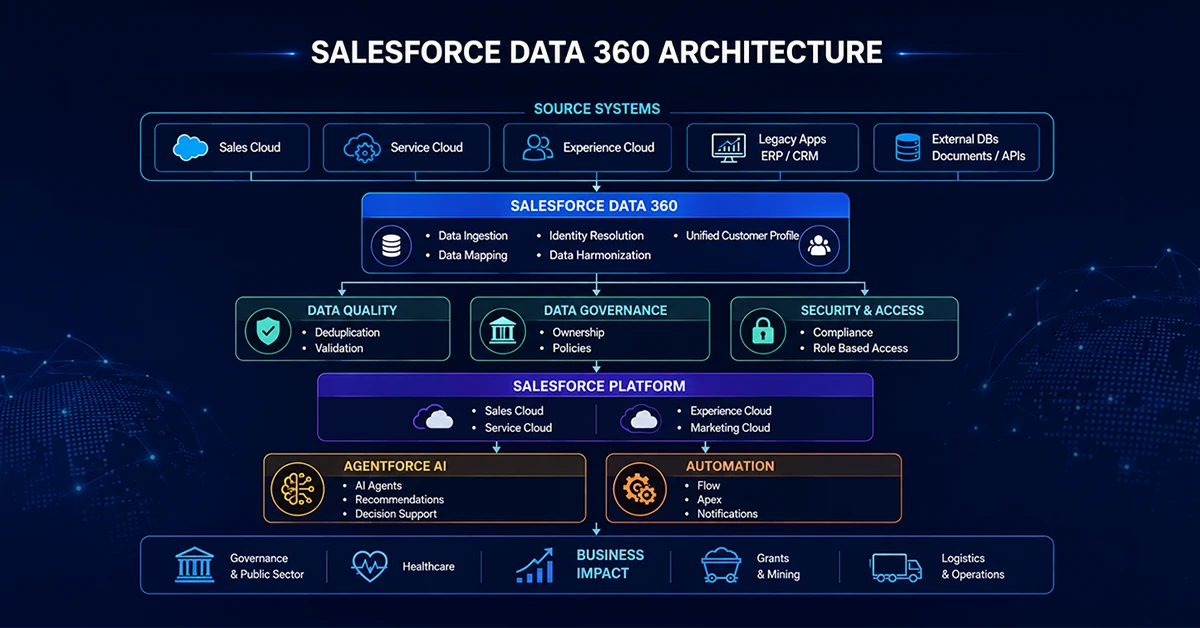
Reading it
left to right, top to bottom, here's the journey the data takes:
- It starts in the systems you already use - Sales Cloud, Service Cloud, Experience Cloud, legacy business systems, or outside databases and documents.
- From there, it's matched, cleaned, and merged into one reliable record per customer, citizen, or account. This is identity resolution doing the heavy lifting.
- Along the way, the data is checked for accuracy, ownership gets assigned, and access is controlled through data governance.
- Only then does it flow back out - into the Salesforce tools your teams already rely on, and into Agentforce agents and automated workflows - so every department is finally reading from the same script.
.webp)
Where Fragmented Data Was Hurting Us the Most
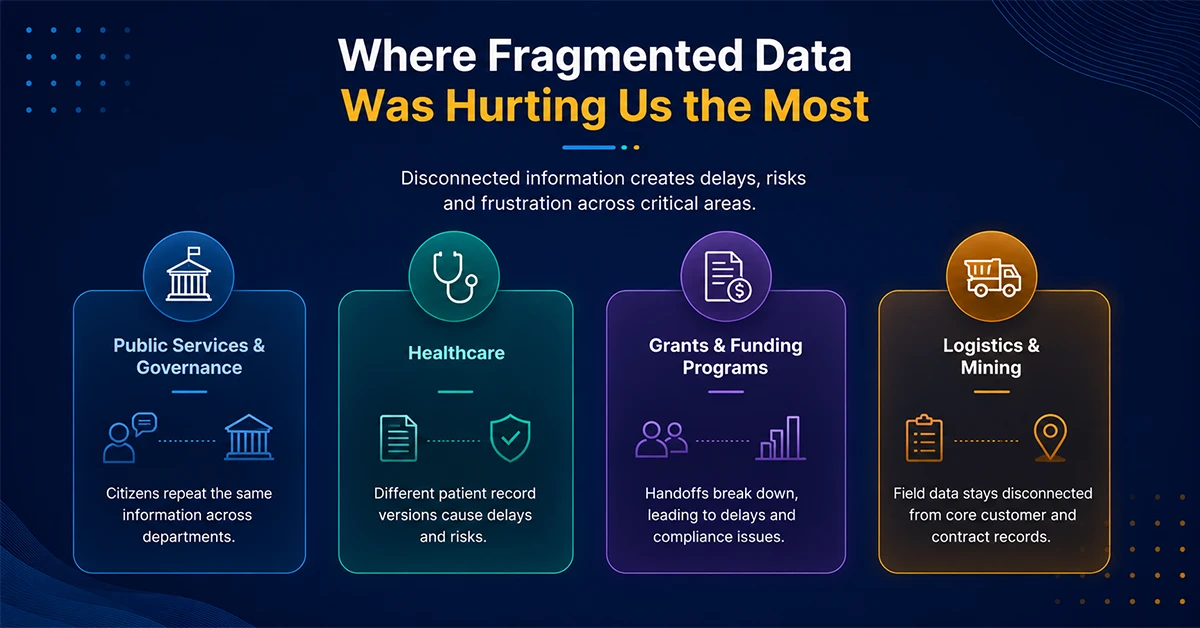
Technology alone isn't the interesting part of this story, though. What matters more is where it actually shows up in day-to-day work. Before rolling this out, we didn't try to fix everything everywhere at once - we asked a simpler question: where is disconnected information costing us the most, right now?
A few clear patterns emerged.
Public Services and Governance
Citizens don't think in departments or case numbers. They think in terms of a single problem that needs solving. When a pension query, a land record request, and a complaint about the same issue live in three different places, the citizen ends up repeating themselves to every new person they talk to.
That repetition wears down trust faster than almost anything else we do.
Healthcare
Clinical staff and administrative staff often work from different versions of the same patient record. A billing delay caused by an outdated insurance detail, or a care decision made without knowing about a recent visit elsewhere - these are exactly the gaps a shared, current record quietly closes.
Grants and Funding Programs
Grant processes pass through many hands: intake, review, award, disbursement, and ongoing monitoring. Every stage depends on the previous team's notes being accurate and complete. When that handoff breaks down, it shows up as delayed awards, missed compliance checks, or funds released against incomplete paperwork.
Logistics and Mining
Field information - asset condition, site compliance, vendor performance - often comes from systems that were never built to talk to core CRM records. Bringing that information into the same shared view as customer and contract data finally lets operational and commercial teams work from the same set of facts.
How We're Bringing Data 360 to Life
At CSM Tech, we didn't treat this as a side project bolted onto our existing Salesforce setup. We treated it as the foundation underneath everything we already run.
One thing we realized early on: this was never going to be a purely technical rollout. It was as much about getting people to agree on shared definitions as it was about connecting systems.
Starting with What We Already Had
Across our sectors - logistics, mining, governance, healthcare, education, and public services - we already hold years of records in Salesforce. The first move was connecting that information, along with relevant outside systems, so duplicate and disconnected records could be resolved into one reliable profile per customer, citizen, or account.
That meant agreeing, sector by sector, on what a single trusted record should actually contain. It turned out to be a business conversation as much as a technical one.
Handing It to the People Who Use It Every Day
Here's what we love about this approach: it doesn't chain every business team to IT just to get value from its own data. Program officers, case managers, and service teams can work with a shared, up-to-date view directly inside the tools they already use every day. No custom report requests. No waiting in a queue.
Fueling Agentforce, Not Just Dashboards
Our Agentforce-driven solutions - grant management, grievance handling, and case management - depend on accurate, real-time context about the person or request in front of them. Data 360 feeds that context.
It's the reason our AI agents can check case history, confirm eligibility, or flag a compliance risk instantly, instead of asking a human to go digging for the answer. The two efforts reinforce each other: cleaner data makes our agents smarter, and every interaction feeds back even more current information.
Agreeing on What "Correct" Even Means
What surprised us most wasn't the technology - it was how much time we spent simply agreeing on definitions. Bringing information together sounds simple. But there's one challenge many organizations underestimate: getting everyone to agree on what "correct" really looks like.
We put clear ownership in place for each area of information, defined how duplicate records get merged, and set rules for who can see and act on sensitive details, so unification never comes at the cost of security or compliance.
Taking It Sector by Sector
Rather than one disruptive, organization-wide switch, we're bringing this online sector by sector, starting where fragmented information causes the most friction today, like public-sector case management and grant administration, and expanding from there. Each rollout teaches us something that makes the next one faster and lower risk.
What We're Already Seeing
It's still
early days. But the patterns showing up match what we hoped for when we
started:
- Case teams are spending noticeably less time searching across systems before they can act on a request.
- Duplicate and conflicting records, a long-standing source of reporting headaches, are being resolved automatically instead of by hand.
- Agentforce agents are making faster, more confident decisions because they're working from one current, trustworthy record instead of scattered fragments.
Bringing It All Together
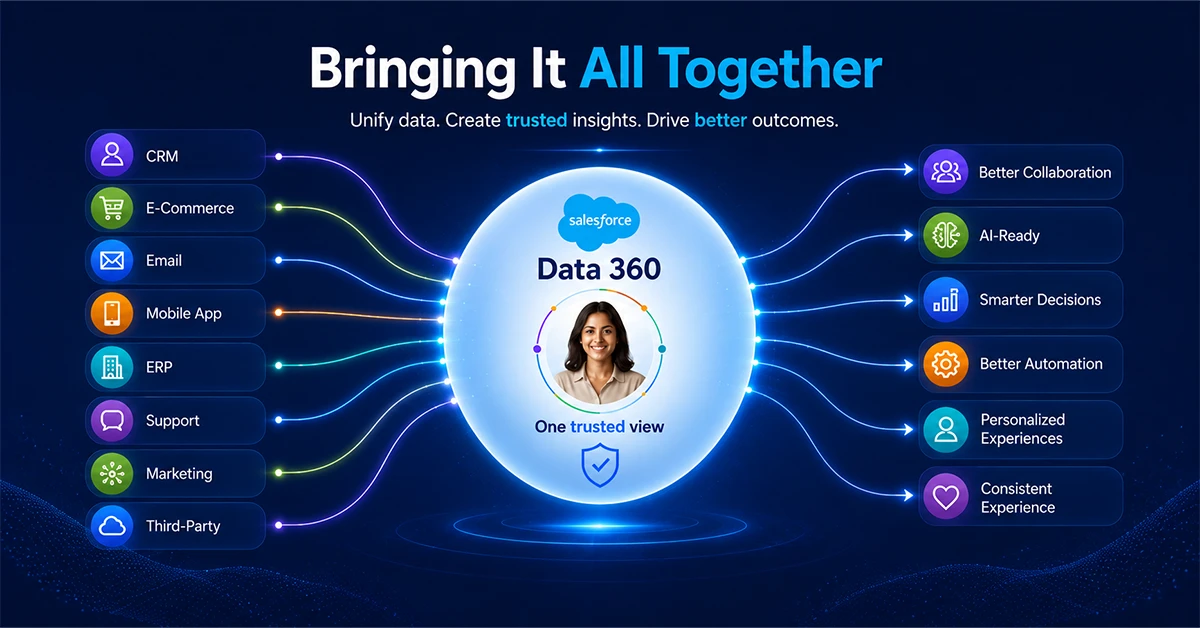
Every organization generates more data than ever before. The real challenge isn't collecting it - it's connecting it in a way that creates meaningful business value.
Salesforce Data 360 helps solve that challenge by bringing information from across systems into a single, trusted view. With a unified foundation, teams can collaborate more effectively, deliver consistent customer experiences, and confidently power AI-driven solutions like Agentforce.
As organizations continue their digital transformation journey, trusted data will remain the foundation for smarter decisions, better automation, and more personalized experiences. Because when every team works from the same version of the truth, technology becomes more than just a tool - it becomes a driver of better business outcomes.
Still flying blind across disconnected systems? Let's map how Salesforce Data 360 can unify your data and power smarter, AI-ready decisions.
Contact Us to talk to our Salesforce experts today!

Want to start a project?
Get your Free ConsultationOur Recent Blog Posts


















































































































































© 2026 CSM Tech Americas All Rights Reserved