


Managing a growing business today means juggling more complexity than ever. And it definitely includes multiple departments, expanding teams, rising customer expectations, and the constant pressure to do more with less. Most businesses reach a point where their patchwork of tools stops being a solution and starts being the problem. Data lives in silos, processes break down at handoffs, and leadership is making decisions based on yesterday's numbers.
That's where Odoo ERP changes the game. Trusted by over 12 million users across 100+ countries, Odoo is an open-source, all-in-one enterprise resource planning platform that brings every corner of your business, including sales, finance, operations, HR, manufacturing, and more into a single, connected system. Whether you're an ambitious growing business or an established enterprise looking to modernize, Odoo gives you the visibility, automation, and agility to move faster and operate smarter.
In this blog, we break down what makes Odoo ERP, one of the most powerful and cost-effective business platforms available today and why more companies are choosing it as the foundation for their next stage of growth.
What Is Odoo ERP and Why Are Thousands of Businesses Switching to It?
If your business is still running on disconnected spreadsheets, standalone accounting tools, and siloed software that doesn't talk to each other, you're leaving money and efficiency on the table.
Odoo ERP is an all-in-one, open-source enterprise resource planning platform that brings your entire business, including sales, inventory, accounting, HR, manufacturing, CRM, and more into a single, unified system. With over 12 million users across 100+ countries, Odoo has become one of the fastest-growing business management software platforms in the world.
The question isn't whether your growing SMB needs an ERP. It's whether you can afford not to have one.
What Makes Odoo ERP Different from Other ERP Systems?
"What is Odoo ERP?" Odoo is a modular, open-source ERP platform offering 30+ core business applications and 40,000+ third-party integrations available in both a free Community edition and a paid Enterprise edition.
Unlike legacy enterprise systems which were built for large corporations and retrofitted for smaller businesses, Odoo was architected from the ground up with flexibility and affordability in mind. Here's what sets it apart:
1. Modular Architecturew: Pay Only for What You Need
With Odoo, there's no bloated one-size-fits-all license. You start with the modules you need today. Let’s say you need Accounting and Inventory and add CRM, Manufacturing, or eCommerce as your business grows. This is especially valuable for small to mid-sized businesses (SMBs) operating with lean budgets and lean teams.
2. Dramatically Lower Total Cost of Ownership (TCO)
A five-year TCO analysis consistently places Odoo well below traditional enterprise ERP solutions. Odoo Enterprise starts at approximately $7.25/user/month with no hidden module fees for core apps. For an SMB with 10–50 users, the savings over five years can amount to hundreds of thousands of dollars, capital that stays in your business instead of going to a software vendor.
3. Open-Source Flexibility with Enterprise-Grade Power
Odoo's open-source Community edition gives businesses complete access to source code, enabling deep customization without vendor lock-in. The Enterprise edition adds advanced features, hosting, and official support, giving growing businesses the best of both worlds.
Key Odoo ERP Modules That Drive Business Growth
Here's a breakdown of the core Odoo modules that SMBs rely on most:
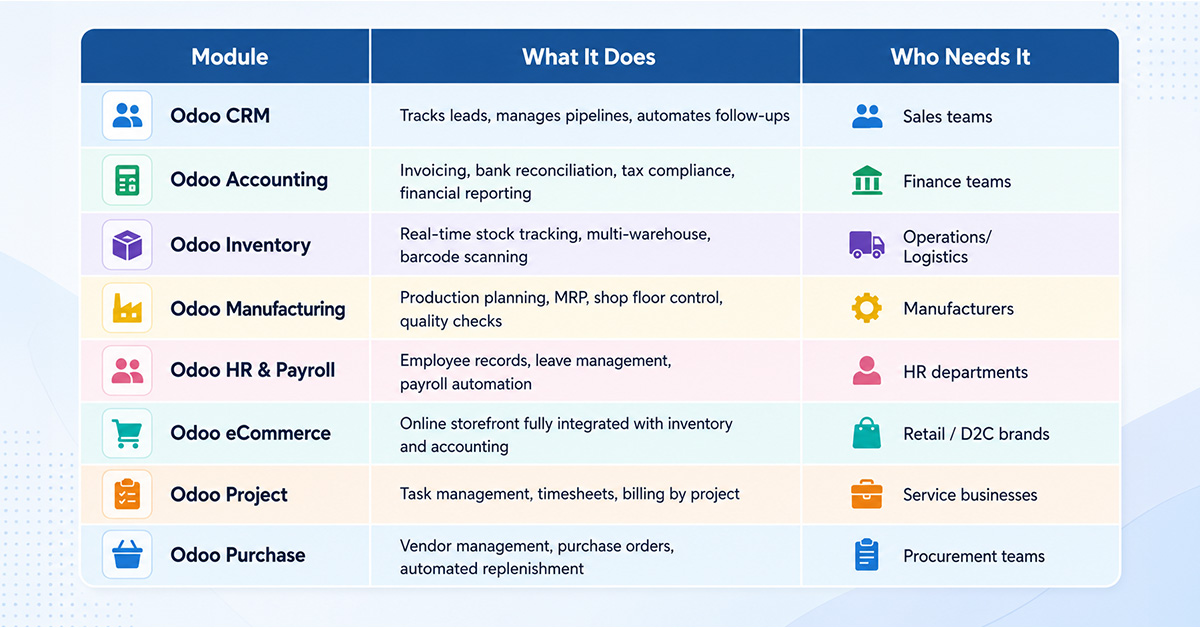
What modules does Odoo include?
Odoo includes 30+ official business applications spanning CRM, accounting, inventory, manufacturing, HR, eCommerce, project management, and more, all natively integrated and manageable from one dashboard.
What Business Problems Does Odoo ERP Solve?
❌ The Problem: Data Silos Killing Productivity
Most growing businesses cobble together a standalone accounting tool, a separate CRM, a standalone HR tool, and maybe a third-party inventory system. The result? Data that doesn't sync, manual re-entry errors, and zero real-time visibility across departments.
✅ The Odoo Solution: One Unified Platform
Every Odoo module shares a single database. When a sales order is confirmed, inventory is automatically updated, an invoice is generated, and the CRM deal is closed, all without a single manual step. This end-to-end automation is where ERP ROI becomes tangible:
- Businesses implementing ERP report decisions made 36% faster
- Operating costs can be reduced by up to 35% post-implementation
- Monthly financial close cycles can shrink from 12 days to just 3
Is Odoo ERP Right for Your Industry?
Odoo is genuinely industry-agnostic, but it performs especially well in :
- Manufacturing & Distribution: Odoo's MRP (Material Requirements Planning) engine, Bill of Materials management, and shop floor control make it a competitive alternative to specialized manufacturing ERPs without the specialized price tag.
- Retail & eCommerce: With a native eCommerce module, integrated Point of Sale (POS), and real-time inventory sync, Odoo gives retail businesses full omnichannel visibility in one system.
- Professional Services: Project-based billing, timesheet tracking, and resource planning make Odoo a strong fit for consulting firms, agencies, and IT service providers.
- Wholesale & Logistics: Multi-warehouse inventory, vendor management, and automated purchase order generation make Odoo a natural fit for distribution businesses managing complex supply chains.
What industries use Odoo ERP?
Odoo is used across manufacturing, retail, eCommerce, professional services, wholesale distribution, healthcare, education, and non-profits. Its modular design means it can be configured to fit almost any industry vertical without heavy custom development.
How Long Does an Odoo ERP Implementation Take?
One of the most common concerns businesses have before adopting ERP is implementation complexity. With Odoo, the reality is more encouraging than most expect:
- Simple deployments (accounting + CRM for a small team): 4–8 weeks
- Mid-complexity deployments (5–10 modules, 10–50 users): 3–6 months
- Complex deployments (manufacturing, multi-warehouse, custom workflows): 6–12 months
The key to a successful Odoo implementation is working with a certified Odoo implementation partner who understands your industry and can configure rather than over-customize the platform to fit your workflows.
How long does Odoo implementation take?
A standard Odoo ERP implementation for a small or mid-sized business typically takes 4 to 16 weeks, depending on the number of modules, users, data migration complexity, and the level of customization required.
Bottom line: For startups and micro-businesses, the Community edition is a powerful free starting point. For SMBs with more than 10 users or complex workflows, the Enterprise edition delivers better ROI through time savings, official support, and advanced automation.
5 Signs Your Business Is Ready for Odoo ERP
- You're managing operations across 3+ disconnected software tools and spending hours reconciling data manually each week.
- You're scaling headcount or revenue and your current systems can't keep up with transaction volume or reporting demands.
- You can't get real-time answers to basic business questions like current inventory levels, outstanding invoices, or team utilization without compiling spreadsheets.
- Customer orders are falling through the cracks due to lack of visibility between sales, operations, and fulfillment.
- Your finance team is buried in month-end close because accounting isn't talking to the rest of the business.
If two or more of these sound familiar, you're not just ready for Odoo ERP, you may already be overdue.
Frequently Asked Questions About Odoo ERP
Q: Can Odoo ERP scale with my business? Yes. Odoo is designed to scale from a solo founder using a single module to enterprises running 50+ modules across multiple locations and legal entities. Its modular structure means you add capability as you grow, without switching platforms.
Q: Is Odoo cloud-based? Odoo offers three deployment options: Odoo.sh (cloud hosting on Odoo's infrastructure), private cloud or on-premises deployment, and Odoo Online (SaaS). Cloud adoption for ERP has reached over 70% among SMBs, and Odoo's cloud options are fully managed with automatic updates.
Q: Does Odoo integrate with other tools? Odoo integrates natively with 40,000+ applications through its App Store, including payment gateways, shipping carriers, eCommerce platforms, marketing tools, and third-party SaaS products. API access is also available for custom integrations.
The Bottom Line: Why Odoo ERP Is the Best ERP for Growing SMBs
The ERP market is projected to grow from $65.2 billion in 2023 to $200.7 billion by 2033. It is driven precisely by small and mid-sized businesses recognizing that modern ERP is no longer just for large enterprises.
Odoo sits at the intersection of affordability, flexibility, and power in a way that few ERP platforms can match for SMBs. Whether you're a 10-person operation ready to graduate from spreadsheets, or a 200-person business with fragmented systems that are holding you back from your next stage of growth, Odoo has the architecture, ecosystem, and partner network to get you there.
Ready to explore Odoo ERP for your business?
CSM Tech as certified Odoo implementation partner can help you get a tailored assessment of which modules fit your operations and what a realistic implementation roadmap looks like. Contact Us!

Want to start a project?
Get your Free ConsultationOur Recent Blog Posts



















































































































































© 2026 CSM Tech Americas All Rights Reserved