

Part of our Spotlight series on the platforms reshaping how mission-driven organizations serve the people who depend on them.
Every day, public servants do something remarkable: they deliver essential services to millions of people, often with lean teams and decades-old systems. What's changed is the bar for what "good service" feels like. The same constituent who renews a license or applies for a benefit also banks, shops, and streams on platforms built for instant, personalized, and always-on experiences. And they happen to bring those expectations to every interaction, including the ones with their government.

Agencies see this clearly, and they're rising to meet it. As per McKinsey, roughly 60% of citizens now prefer to engage with government through digital channels, and the payoff for meeting them there compounds: Deloitte's research finds that the quality of a government's customer experience is one of the strongest predictors of public trust. Better digital service, in other words, isn't a nicety, it's one of the most direct ways to strengthen the bond between people and the institutions that serve them. The opportunity is real and well within reach: Deloitte pegs the remaining digital-experience gap with the private sector at about 21 percentage points, and closing it is exactly where smart modernization pays off for constituents and for the public servants who support them.
And the momentum is unmistakable: the public sector is leaning in. As per NASCIO's 2025 State CIO Top 10 Priorities, artificial intelligence claimed the number-one spot for the first time ever, ending cybersecurity's 12-year reign. As per Gartner, more than 60% of government organizations will prioritize investment in business process automation by 2026, up from just 35% in 2022. And as per a 2024 EY study, 89% of U.S. federal agencies and 92% of state and local governments are committed to delivering constituent-centric services. The appetite for modernization is real. The open question is which platform can deliver it securely, at scale, and fast.
This is where Salesforce has built a genuine public-sector advantage, and where, as an implementation partner, we help agencies convert that advantage into outcomes.
Built for government from the ground up
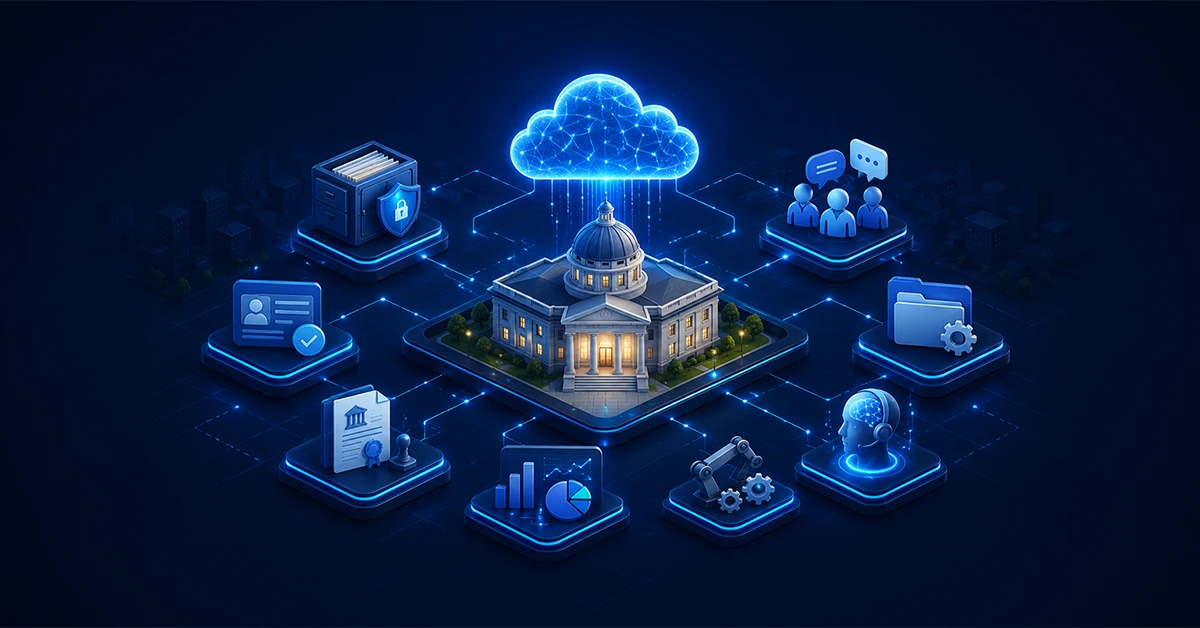
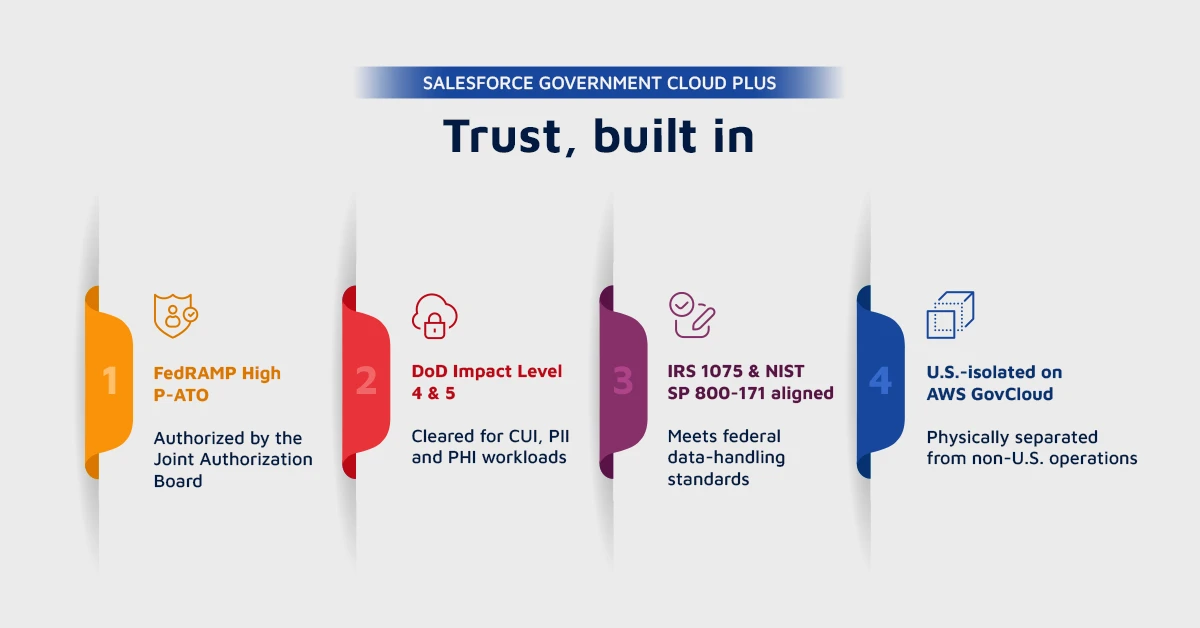
Most enterprise software is retrofitted for the public sector. Salesforce's government stack was architected for it. Salesforce Government Cloud Plus is a dedicated environment designed to clear the bar that matters most to agencies: trust.
That compliance posture including FedRAMP High authorized by the Joint Authorization Board, provisional authorization at DoD Impact Levels 4 and 5, plus alignment to IRS 1075 and NIST SP 800-171 means agencies can store and process controlled unclassified information, PII, and PHI without bolting on a separate security program. The accreditation work that public-sector teams would otherwise shoulder is largely carried for them.
Compliance is the entry ticket, not the destination. On top of that foundation, Salesforce gives agencies a connected stack that replaces a graveyard of disconnected systems:
- Public Sector Solutions : Purpose-built applications for licensing and permitting, inspections, case and complaint management, benefits and grants, and constituent engagement, so teams configure rather than custom-build.
- Data Cloud : Unifies constituent data scattered across departments into a single, real-time profile, which is the precondition for both good service and trustworthy AI.
- MuleSoft: Connects the mainframes, legacy databases, and third-party systems that agencies can't simply rip out, turning brittle integrations into reusable APIs.
- Tableau: Turns operational data into dashboards leaders and oversight bodies can actually act on.
- Agentforce: The agentic AI layer that puts a digital workforce to work alongside government staff.
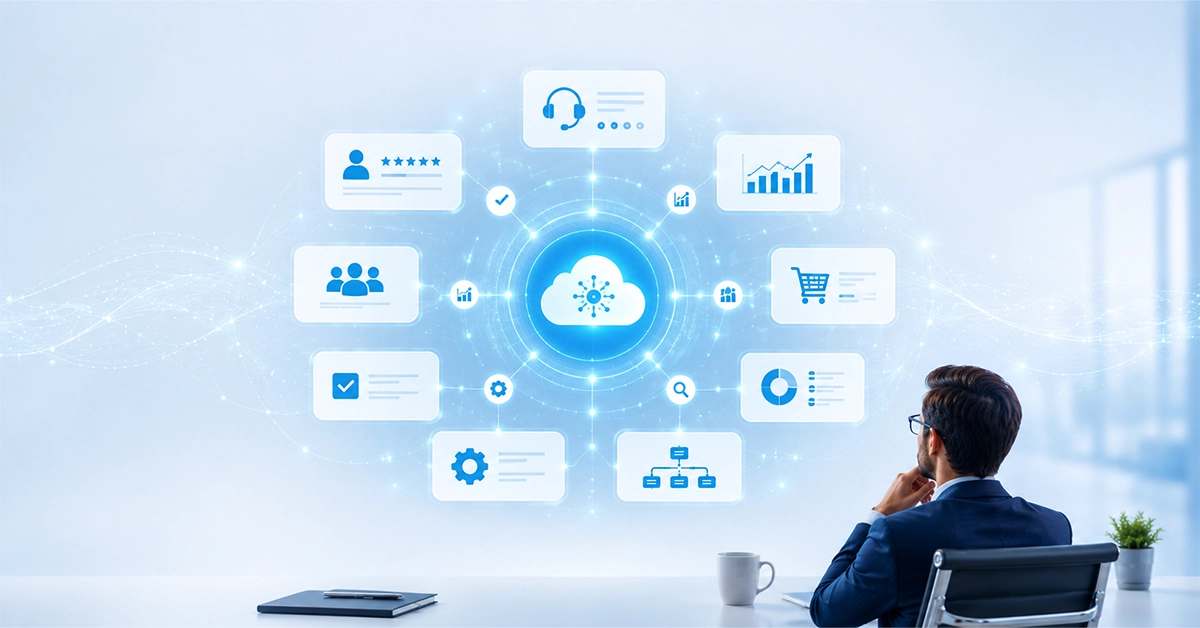
The strategic point is integration. When constituent data, workflows, integrations, analytics, and AI sit on one platform, an agency stops playing detective across silos and starts delivering the seamless, anticipatory service citizens already get from the private sector.
Agentforce: a digital workforce for the public sector
The most consequential recent development is agentic AI. In August 2025, Salesforce launched Agentforce for Public Sector - AI agents that autonomously handle time-consuming government work within defined guardrails, rather than another chatbot bolted onto a broken process.
The early use cases are pragmatic, not science fiction. Compliance Management agents help inspectors recommend code violations, calculate regulatory fees, and draft documentation. Complaint Management agents triage and curate the flood of constituent complaints. Recruitment Management agents accelerate government hiring.
This isn't a fringe experiment. As per IDC research conducted for Salesforce, 82% of public-sector organizations have already adopted AI agents. The agencies winning here aren't the ones deploying the most agents. They're the ones deploying them on a governed, compliant platform where every action is auditable. For risk-averse government buyers, that governance is the unlock, not the obstacle.
.webp)
What we do as your Salesforce public-sector partner
A platform this capable only pays off when it's implemented with public-sector reality in mind: procurement cycles, accessibility mandates, oversight, and change-resistant cultures. That's our job. We help across the full lifecycle:
- Strategy and roadmap: Modernization roadmaps tied to mission outcomes and budget realities, not open-ended time-and-materials.
- Public Sector Solutions implementation: Configuring licensing, permitting, case, complaint, benefits, and inspection workflows to your statutes and processes.
- Agentforce and AI enablement: Designing, deploying, and governing AI agents with human-in-the-loop guardrails and full auditability.
- MuleSoft integration: Connecting legacy systems of record so modernization doesn't mean ripping out what works.
- Data Cloud and analytics: Unifying constituent data and standing up Tableau dashboards for service and oversight.
- Compliance-aligned delivery: Implementing within Government Cloud Plus, aligned to FedRAMP, DoD IL4/IL5, IRS 1075, NIST 800-171, and Section 508 accessibility.
- Adoption and managed services: In-person change management, training, and ongoing optimization, because in government, adoption and not deployment is where value lands.
We connect Salesforce's capabilities to the outcomes you're accountable for: faster service, lower cost to serve, stronger compliance, and renewed public trust.
.webp)
The bottom line
The public sector is at an inflection point. Citizens expect private-sector experiences, budgets are tightening, legacy systems are holding mission delivery hostage, and for the first time, AI sits at the very top of the technology agenda. Salesforce offers a rare combination for this moment: a platform built for government trust, a connected stack that ends the silos, and an agentic AI layer that's already serving constituents today. The advantage is real. Capturing it is a matter of execution.
Ready to turn the public-sector advantage into measurable outcomes? Explore and Connect Us!

Want to start a project?
Get your Free ConsultationOur Recent Blog Posts





























































































































© 2026 CSM Tech Americas All Rights Reserved