blog

Part 2 of our ServiceNow Spotlight series. In Part 1, we unpacked the ServiceNow AI Platform and the shift from resolving problems faster to preventing them altogether. Here, we look at the piece that makes that shift possible and what it means for the business.

Why this matters beyond the IT department

When a system goes down, IT isn't the only one who feels it. Sales can't process orders. Customer service can't pull up accounts. Employees sit idle waiting for a fix. And leadership is left explaining the outage to customers or the board.

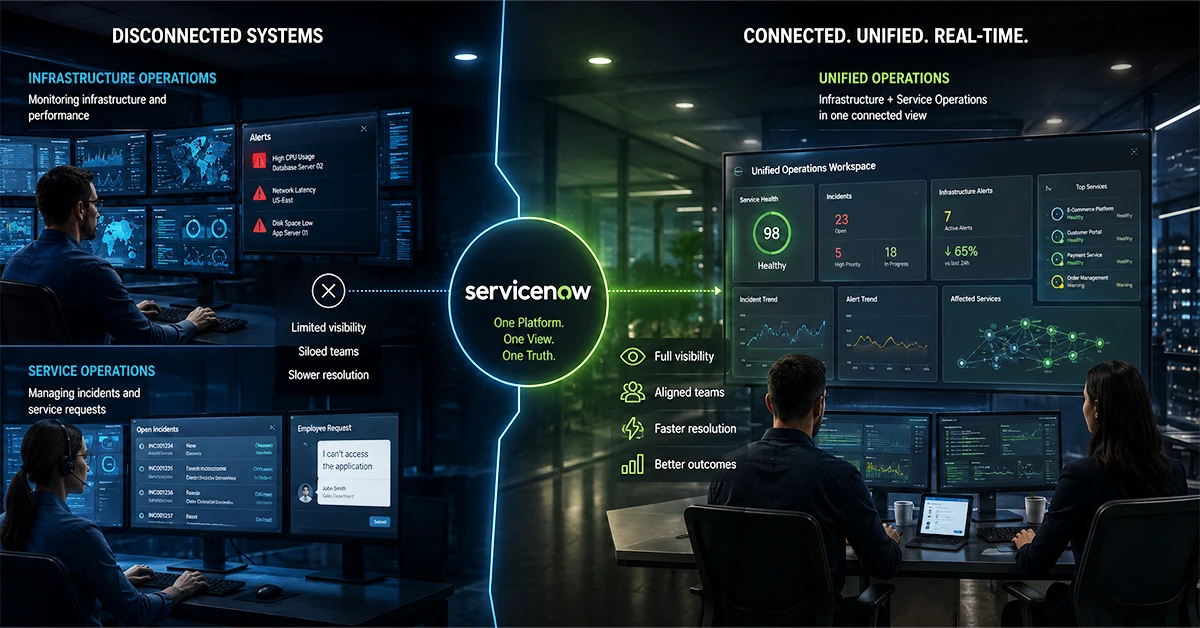
Yet in most companies, the teams who could prevent that outage and the teams who respond to it are working from two different systems that don't talk to each other. One team watches the infrastructure. Another team handles the complaints once something breaks. By the time the two connect the dots, the business has already lost time, money, and a bit of customer trust.

This isn't a small problem. A single hour of unplanned downtime costs most mid-size and large enterprises upwards of $300,000, and for high-impact outages, that figure can run into the millions. IT teams also report spending nearly a third of their time firefighting instead of doing the work that actually moves the business forward.


The fix: one connected view, instead of two disconnected teams

ServiceNow's approach, called Autonomous Service Operations, brings IT's two major functions onto one shared platform:

  • The team that watches the infrastructure (servers, networks, cloud systems) so problems can be caught early.
  • The team that manages requests and incidents raised by employees and customers.

Instead of these two functions working in silos with separate records and separate views, they now share one live picture of what's happening across the business. When something starts to go wrong, both teams see it immediately, with full context about which systems, services, and customers are affected.

Think of it like a hospital where the diagnostic equipment and the doctors used to be in separate buildings, checking in with each other by phone. Now they're in the same room, looking at the same monitor, in real time.

From “fix it fast” to “fix it before anyone notices”

The real value isn't just speed, it's prevention. With one connected view, the system can learn what “normal” looks like for the business and flag something unusual before it turns into an outage. In many cases, routine issues can be resolved automatically, with clear rules and human oversight, before an employee or customer is ever affected.

This is a meaningful shift for leadership. Instead of measuring success by how fast the team responds to a crisis, you start measuring success by how many crises never happen at all.

What this means for the business

  • Lower costs. Fewer outages and faster resolutions directly reduce the financial impact of downtime.
  • Happier employees and customers. Problems get caught before people are affected, instead of after they've already complained.
  • More productive IT teams. Less time spent firefighting means more time spent on projects that grow the business.
  • Fewer surprises for leadership. A clearer, real-time view of operations means fewer “why didn't we know about this sooner?” conversations.
  • A stronger foundation for AI. Every AI capability ServiceNow offers, from smart assistants to autonomous agents, depends on accurate, connected data. Getting IT's two functions talking to each other is what makes that AI trustworthy in the first place.

That last point matters most for anyone thinking about AI adoption. AI is only as good as the information it's working with. Bringing these two functions together isn't a technical nice-to-have, it's what determines whether your AI investment actually pays off.

How we help you get there

Bringing these two functions together isn't an overnight change, but it also doesn't require throwing out what you already have. We help organizations by:

  • Assessing where the gaps are between current tools and teams, and prioritizing the fixes that pay off fastest.
  • Cleaning up and connecting the data that both functions rely on, so it reflects what's actually happening in the business.
  • Reducing noise, so teams see the issues that matter instead of getting buried in alerts.
  • Aligning teams and workflows, so handoffs between departments stop costing time.
  • Introducing AI capabilities once the foundation is solid enough to support them reliably.

The bottom line

You can't automate or AI your way past a trust problem. When the teams protecting your systems and the teams supporting your people finally share one view, the business feels the difference: fewer outages, faster fixes, and a stronger base for whatever AI capability comes next.

Curious where your organization stands today? Explore and Contact Us and we'll help you map the fastest path to a more connected, resilient operation.

FAQs

1. What's the difference between the two IT functions this blog talks about?

One function focuses on the infrastructure (servers, networks, cloud) and catching problems early. The other manages the requests and incidents raised by employees and customers. Traditionally, these run separately.

2. Why does connecting them matter for the business, not just IT?

Downtime affects everyone: sales, customer service, employee productivity, and customer trust. Connecting these functions means problems get caught and fixed before the business feels them.

3. Do we need to replace our current systems to do this?

Not necessarily. ServiceNow is built to integrate with most existing tools, so this is often about connecting and organizing what you already have, not starting from scratch.

4. How does this connect to AI adoption?

AI tools are only as reliable as the data behind them. A connected, accurate view of operations is what makes AI recommendations and automation trustworthy.

5. What's a realistic first step?

Start with an honest look at where your current tools and teams are disconnected, and where that's costing you the most time or money.

Our Recent Blog Posts

blog
Consulting

Salesforce for Nonprofit Organizations

blog
Ai Application

Agentic AI: Building Agentic AI on Salesforce

blog
Consulting

Power BI: More Than a Dashboard, A Decision Support System for Organization

blog
Consulting

From APIs to AI Tools: Building MCP Servers with MuleSoft

blog
Consulting

Salesforce: The Public Sector Advantage

blog
Consulting

ServiceNow Spotlight: Building the Self-Running Enterprise on the ServiceNow AI Platform

blog
Ai Application

From AI Potential to Business Impact: How Azure AI Is Transforming Enterprises

blog
Consulting

Odoo ERP: One Platform to Unify, Automate, and Scale Your Entire Business

blog
Consulting

Transforming Case Management for Public Sector Agencies with Salesforce

blog
Consulting

Informatica: Building the Foundation for Trusted, Governed Data

blog
Consulting

Tableau: Making Data Visible, Actionable, and Trusted

blog
Consulting

Slack as a Work OS Transforming Enterprise Productivity

blog
Ai Application

How AI-Powered Agents Are Transforming Public Service Delivery
blog
Consulting

Digital Grants Management for Transparency and Compliance

blog
Consulting

Transforming Student Admission for Digital Campuses

blog
Consulting

From Procurement to Delivery: Building a Connected Supply Chain with Odoo

blog
Consulting

Document Management System: Strengthening Security, Governance and Risk Control

blog
Consulting

How a Grants Management System Improves Accountability and Reduces Leakage


blog
Consulting

Reducing Downtime and Waste with Odoo’s Maintenance & Quality Modules

blog
Consulting

Composable ERP: Why Modular Architecture Is the Future, and How Odoo Leads

blog
Consulting

Legacy ERP vs Modern ERP: How Odoo Redefines Manufacturing Agility

blog
Consulting

Building Smarter: How Odoo Transforms the Construction Industry

blog
Analytics And Insights

Spatial Computing for Data Visualization: Turning Complex Data into Immersive Insights

blog
Consulting

Top 5 Challenges in Manufacturing ERP — and How Odoo Solves Them

blog
Consulting

Beyond ERP: How Odoo Becomes the Digital Backbone for Modern Enterprises

blog
Analytics And Insights

What is a Data Mesh? A Simple Guide for Businesses

blog
Analytics And Insights

5 Simple Strategies for Data Migration

blog
Analytics And Insights

The Ultimate Guide on DataOps: Streamlining Data for Business Success

blog
Custom App Development

What is Vibe Coding? A Game-Changer for Software Development

blog
Ai Application

What is Augmented Analytics? Unlocking B2B Insights with AI

blog
Ai Application

Agentic AI for Real-Time Data Pipelines: Unlocking Next-Level Business Agility

blog
Ai Application

Edge AI and CDC: Powering Enterprises with Low-Latency Analytics

blog
Ai Application

Revolutionizing Business Intelligence with AI in 2025

blog
Consulting

Data Mining in Business Intelligence

blog
Analytics And Insights

Change Data Capture (CDC): What It Is and How It Works

blog
Ai Application

Agentic AI: Transforming Operations with Autonomous Intelligence

blog
Analytics And Insights

Ensuring Robust Cloud Security: Safeguarding Enterprise Data in the Digital Age

blog
Analytics And Insights

How Master Data is Foundational to Business Transformation?

blog
Custom App Development

Enterprise Application Development: A Complete Guide

blog
Ai Application

What’s good for you: Agentic AI vs. Generative AI

blog
Custom App Development

How Android Consultants Help in Selecting the Right Tech Stack for Your App

blog
UI/UX

Designing with Purpose: How Prototyping Ensures Functional UI/UX Designs

blog
Consulting

Edge Computing: Why It Matters

blog
Consulting

Maximizing ROI in IT Projects Through Strategic Staff Augmentation

blog
Consulting

Using RAID Logs Can Transform Your Project Management

blog
Ai Application

How Multimodal ML Enables Human-Like AI Processing

blog
Consulting

A Guide for CIOs: Steps To Creating A Successful IT Strategy

blog
UI/UX

Advanced Strategies for Prototyping in UI/UX Design: A 2025 Perspective

blog
Ai Application

Agentic AI Is Here, And Looks Like It Will Stay

blog
Custom App Development

Leveraging Oracle APEX for Low Code Development

blog
Consulting

The Days of SaaS Are Numbered, Evolution Key To Survival

blog
Staff Augmentation

IT Staff Augmentation: A Strategic Tool for Resource Optimization in Projects

blog
Consulting

Navigating the Challenges of Global Team Collaboration in 2025

blog
Consulting

Spend Less on Cloud With These Ten Strategies

blog
Ai Application

Why Data is important in AI Development

blog
Custom App Development

How Custom Software Can Boost Your Business’s Competitive Edge

blog
Consulting

Reimagining Resource Strategy With A Product-Centric Approach

blog
Ai Application

AI in Finance: Preparing Enterprises For The Next Phase of Evolution

blog
UI/UX

Getting Creative With Designs Sprints and an Innovation Mindset

blog
Consulting

Getting Ahead of the Waterfall vs. Agile Struggle

blog
Ai Application

How is AI Transforming Education?

blog
Staff Augmentation

Key Trends in IT Staff Augmentation for Project Management in the USA

blog
Ai Application

The Next Wave of Automation Is Coming To Healthcare

blog
Ai Application

Fundamentals of AI Development

blog
Ai Application

Integrating GenAI With Your Business For High Productivity

blog
Ai Application

Data Labeling Strategies To Supercharge Your LLMs

blog
Consulting

Digital Identity: Technology & Platforms

blog
Consulting

Key SOC Trends That Will Affect Organizations in 2024

blog
Consulting

Building Strategy For Data Protection and Privacy Compliance

blog
Custom App Development

How to Build a Fintech Application

blog
Ai Application

Managing The AI Project Management Lifecycle

blog
Analytics And Insights

Data Migration Validation : Best Practices

blog
Ai Application

AI in Project Management: Enhancing Efficiency and Outcomes

blog
Custom App Development

Low-Code/No-Code Frameworks: Redefining Enterprise Productivity

blog
Consulting

Tips to Deliver Better Digital Customer Experience

blog
Consulting

Is Your Legacy System Holding Your Business Back?

blog
Analytics And Insights

Data Governance: Navigating the Complexities of the Data-Driven Era

blog
Consulting

How to Choose the Right Document Management System?

blog
Consulting

ERP Modernization Crisis: Challenges and Solutions in the U.S. Enterprises

blog
Analytics & Insights

AI Era, More Data, More Analytics: Top 10 Predictive Analytics Tools in 2024

blog
Ai Application

A Visual Imperative: Transforming Enterprise Data into Decisive Action

blog
Consulting

Cloud Migration for Enterprises: A Comprehensive Overview

blog
Analytics & Insights

Interactive Data Visualization: Accelerate Decision-Making

blog
Consulting

15 Reasons Every Enterprise Should Use Tableau Instead of Power BI

blog
Ai Application

Overcoming Enterprise AI Strategy Hurdles

blog
Custom App Development

Application Migration: The Essentials

blog
Staff Augmentation

How IT Staff Augmentation is Revolutionizing IT Project Management in the USA

blog
Ai Application

Sunshine State's Digital Renaissance: How Florida can Boost Tourism with Smart Tech

blog
Analytics & Insights

Transforming Grant Management: Embracing Technology for Better Outcomes

blog
Ai Application

Automating Success: Why U.S. Enterprises Are Betting Big on AI

blog
Staff Augmentation

A Guide to Strategic Staffing Solutions

blog
Ai Application

How to Build a Successful AI Strategy for Your Business?

blog
Analytics & Insights

Data Lake and Data Warehouse: What's the Difference?

blog
Consulting

Data Migration: Complexities, Challenges and Solutions

blog
UI/UX

The Role of Prototyping in UI/UX Design: From Concept to Execution

blog
Custom App Development

Behind Innovations: Sneak-peek into the Mind of a CSM Tech Developer

blog
Ai Application

The Transformative Impact of AI on Cybersecurity Practices

blog
Custom App Development

Agile Development: A Living Manifesto for a Changing World

blog
Consulting

Adopting DevOps for Organizational Transformation

blog
Ai Application

Exploring The New Essential: Digitalization of Florida’s Tourism and Hospitality Industry

blog
Ai Application

Generative AI: Security and Governance Strategies

blog
Consulting

The Healthcare Cloud: New Horizons for Improved Outcomes

blog
Ai Application

Streamlining Business Functions with AI, ML and IoT

blog
Consulting

Optimizing Florida's Food Supply with Data-Driven Insights

blog
Consulting

An Overview of Global Data Protection Laws

blog
Ai Application

Navigating Beyond Borders with AI

blog
Ai Application

How Is AI Transforming various Departments in an Enterprise?

blog
Consulting

The Promise and Peril of AI in Healthcare

blog
Consulting

AI under the Mistletoe: Transforming Holidays into a Tech Wonderland

blog
Staff Augmentation

The Holiday Advantage of IT Staff Augmentation for Your Business

blog
Consulting

Enterprise AI: Adoption Strategy and Applications

blog
Consulting

Quick-Service Restaurants Turn to AI to Manage Pandemic Woes

blog
Consulting

Artificial Intelligence: Unlocking Success in Retail Landscape

blog
Consulting

Tracking The Rise of Artificial Intelligence in Banking

blog
Custom App Development

How is AI Revolutionizing the Mining Industry

blog
Custom App Development

AI for Payroll: Powering Companies of The Future

blog
Consulting

GenAI: Watershed Moment for Human Resources Management

blog
Consulting

How AI is Transforming the Supply Chain Industry

blog
Consulting

AI for Legal: Scales of Innovation Seek New Balance

blog
Consulting

Moonshot for Preventive Healthcare: AI + Analytics

blog
Consulting

How to Implement Generative AI for Your Enterprise?

blog
Consulting

How Much AI Is Enough for Civil Aviation?

blog
Analytics & Insights

What is Data Governance? Why is it important for your business?

blog
Custom App Development

Enterprise Application Development: Challenges and Their Solutions

blog
Custom App Development

How to Choose the Right Software Development Company: Do's and Don'ts

blog
Consulting

Navigating Risks and Opportunities of AI Explosion

blog
Custom App Development

Why Businesses Need Tableau Implementation Services to be Data-driven

blog
Custom App Development

JAVA: Take a Deep Dig into The Top Most Programming Language

blog
Consulting

How to Maximize Customer Delight with Odoo Financial Management

blog
Consulting

How Odoo Consulting Companies are Democratizing ERP for Businesses

blog
Staff Augmentation

Offshore IT Staff Augmentation; A Competitive Edge for The Company

blog
Custom App Development

Strengthen your Team with Unwavering Commitments from Python Experts

blog
Custom App Development

How Emerging Tech is Speeding up Digital Transformation in BFSI

blog
Custom App Development

Change the Way You Manage your Finances Digitally!

blog
UI/UX

How to Design a Seamless UX for Online Banking Platforms

blog
Custom App Development

How custom software can Enhance CX in BFSI Firms

blog
Custom App Development

Digital Acceleration of Financial Services through Custom Software

blog
Custom App Development

The Role of Custom Software in Enabling Digital Transformation in the BFSI Industry

blog
Custom App Development

How Custom Software Enhances Operations & Efficiency in Banks and Insurance Companies

blog
UI/UX

Increasing User Engagement and Retention in Financial Apps Through Personalized Interfaces

blog
Staff Augmentation

Why Your Business Needs Staff Augmentation [And How to Make It Work for You]?

blog
Custom App Development

5 Key Questions CTOs Should Ask Before Starting a Custom Software Development Project

blog
Custom App Development

The Benefits of Custom Software Development for Your Company's Bottom Line

blog
Custom App Development

Why Agile Methodologies empower Custom Software Development Projects

blog
Staff Augmentation

Most In-Demand Skills for Software Development Staff Augmentation

blog
Staff Augmentation

Outsourcing IT Development with Staff Augmentation Model

blog
Staff Augmentation

5 Ways to Get the Best out of Staff Augmentation

blog
Staff Augmentation

06 Most Common Myths about IT Staff Augmentation Services Debunked

© 2026 CSM Tech Americas All Rights Reserved