



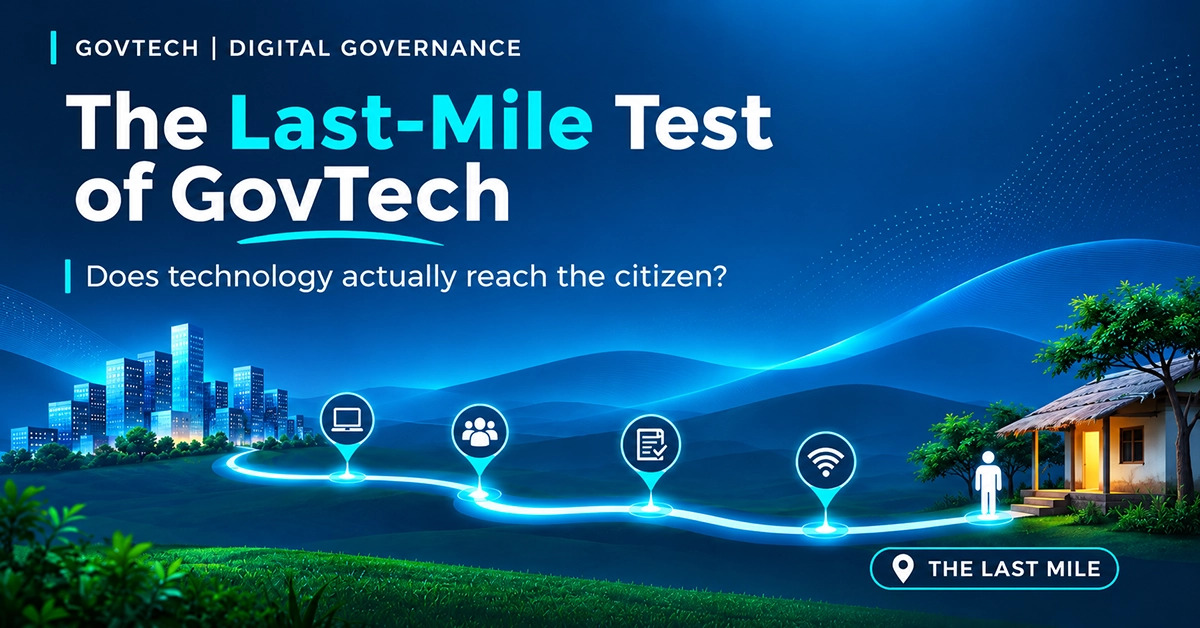
The Last-Mile Test of GovTech: Does Technology Actually Reach the Citizen?
 Priyadarshi PanyManaging Director & CEO
A government portal can serve a million users and still leave a deserving farmer waiting outside an office. That is the paradox of digital governance: technology can travel at the speed of software, but public service delivery moves only as fast as its last mile.
India's Aadhaar, UPI, DigiLocker and Direct Benefit Transfer (DBT) have demonstrated the transformative power of Digital Public Infrastructure (DPI). Yet digitizing a service does not automatically democratize access. For a senior citizen struggling with an application, a tribal farmer navigating unfamiliar language or a rural family without reliable internet, a digital interface can become another bureaucratic barrier.
Why GovTech Often Stumbles at the Last Mile
- Technology without trust creates users, not believers.
- Digital services without local languages create access, not inclusion.
- Data silos across departments create systems, not solutions.
- Complex interfaces create transactions, not experiences.
The UN E-Government Survey 2024 reminds us of this paradox: strong digital infrastructure does not automatically translate into equitable citizen outcomes.
So, how do we know whether GovTech is genuinely reaching citizens?
I believe every digital governance initiative must pass five tests defined by the 5P approach:
People-centred: Is the service designed around citizens' needs rather than departmental convenience?
Participatory: Can citizens provide feedback and influence service improvement?
Proximate: Are services accessible through local languages, assisted channels and grassroots institutions?
Platform-enabled: Do interoperable systems eliminate departmental silos and repetitive documentation?
Performance-accountable: Are governments measuring resolved grievances and actual benefits delivered, rather than portals launched and applications processed?
This 5-P approach shifts the conversation from technology deployment to measurable citizen impact.
At CSM Technologies, we translate this philosophy into population-scale GovTech. From Odisha's Aadhaar Authentication Framework, which has processed over 1.14 billion authentications to AI-powered conversational interfaces, grievance management and GO-SUGAM for farmers, our solutions make public services more accessible, connected and accountable. Our work across India and Africa reflects one conviction: technology must adapt to people, not the other way around.
The real measure of digital India is not how far technology has travelled, but how little distance a citizen must travel to receive a public service.
The best GovTech behaves like electricity: nobody admires it though everyone depends on it. Technology passes the last-mile test only when the citizens stop noticing the technology.