



















There’s a moment every professional knows too well- 15 browser tabs open, three chat threads half-answered, a report due in an hour, and somehow, paradoxically, nothing actually getting done. We call it productivity. Science calls it an illusion. I have lived that chaos. Rebuilding my focus changed how I lead, think, and deliver.
There was a time when multitasking was worn like a badge of honour- an invisible medal for the perpetually busy. I wore it too. Back-to-back calls, emails mid-meeting, presentations stitched between notifications. It felt productive. It wasn’t.
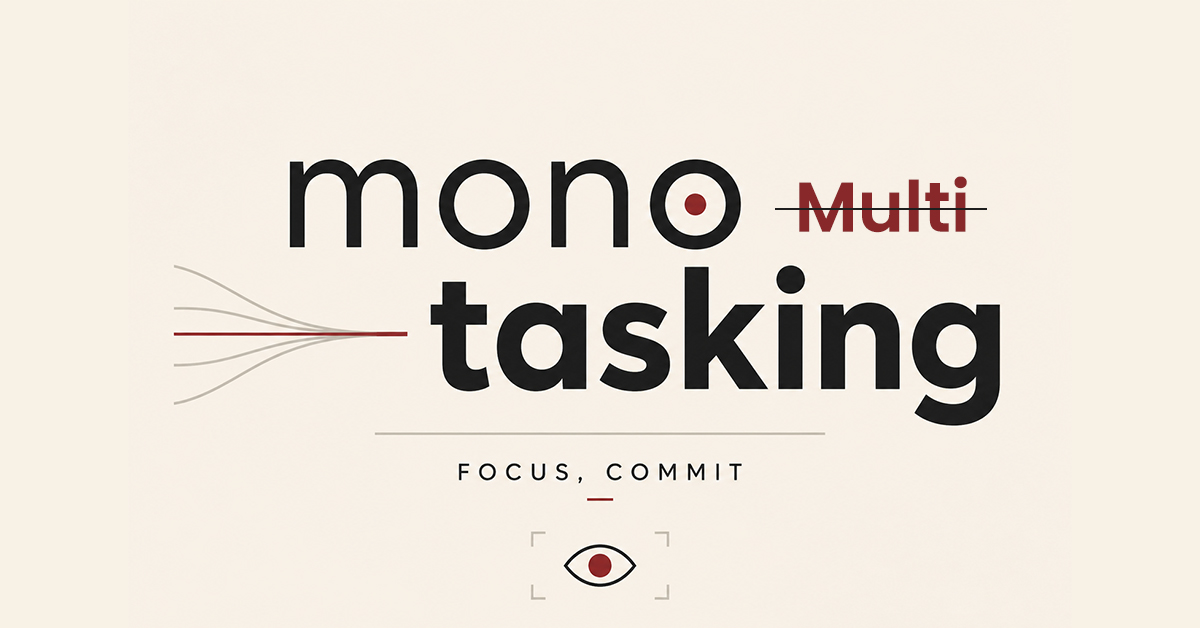
What we glorify as multitasking is, in reality, cognitive fragmentation.
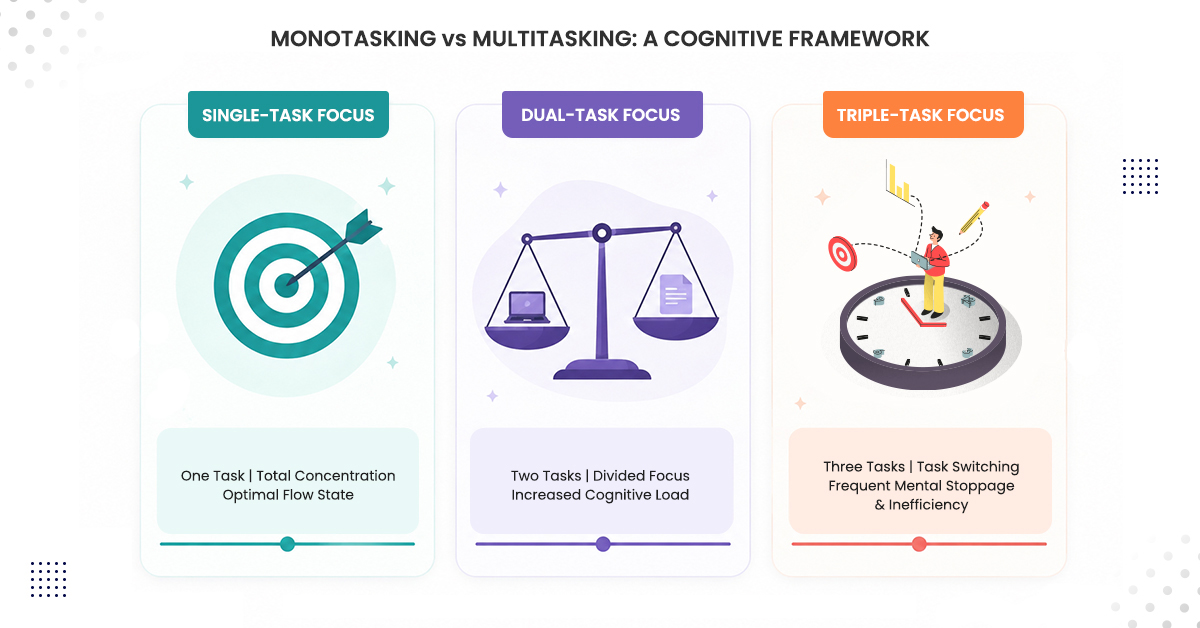
Research referenced by institutions like Harvard Health Publishing shows the brain doesn’t truly multitask- it task-switches. Every switch carries a hidden tax. Productivity drops while errors rise. In business terms, that’s not efficiency; it’s silent erosion.

The Myth of Multitasking in the Digital Age
In today’s hyper connected workplace, distractions don’t knock- they stream. Notifications, messages, dashboards, alerts, each demanding micro-attention. The result? Professionals constantly “on” but rarely fully present.
I have realized this even in meetings. Whenever I call one, I try to set a clear agenda and create a shared sense of purpose. I remind people to “get into the zone” for the reason we are meeting. Unless people mentally wear that one hat in that one moment, distractions creep in and outcomes weaken.
Think of the brain as a high-performance processor. Every task switch forces it to close one mental application and reload another. Repeated often enough, even the fastest system slows down.
This is where monotasking- the discipline of focusing on one task at a time becomes a strategic advantage. It removes switching costs and enables the “flow state”: that rare zone where time fades and output peaks.
Deep Work, Better Output
The most defining breakthroughs in my work- whether strategic decisions or creative insights, have never emerged from divided attention. They came from uninterrupted thinking.
Monotasking sharpens reasoning, reduces rework, and lowers the stress created by constant context-switching. It replaces the chaos of “doing everything” with the calm of “finishing something.”
But monotasking is simple, not easy. It requires retraining a brain conditioned for distraction. Start small: focus on one task for 20 uninterrupted minutes. Silence notifications. Close unnecessary tabs. Protect attention like a scarce resource, because it is.
In a world racing towards AI and digital acceleration, the real competitive edge may not be speed, but depth.
That’s because productivity isn’t about doing more things at once.
It’s about doing one thing so well that everything else becomes irrelevant.
One task. Full mind. Every time.


Recent Publications






- Agriculture and Allied Services
- AgriTech
- Application Development
- Artificial Intelligence
- Blockchain
- COVID-19
- CSM Editorial
- Data Analytics
- Digital service
- Digital Transformation
- Education
- EduTech
- Emerging Technologies
- Enterprise Resource Planning
- Food Security
- Golden Records
- GovTech Solution
- Green Jobs
- Healthcare
- HR Analytics
- Hybrid Work Culture
- Independence Thought
- Industry 4.0
- Innovation
- IT Consulting
- Land & Industry
- Life@CSM
- Memory Lane
- Mines & Minerals
- Mining Technology
- Opinion Piece
- Precision Agriculture
- Smart City
- Social Listening
- Social Media
- Social Registry
- Super Apps
- Tourism
- User Experience
- Web 3.0
- Work Culture
















We will verify and publish your comment soon.