India’s digital public infrastructure enables large-scale delivery of citizen services across governance, finance, telecom, and welfare ecosystems. Aadhaar serves as a foundational digital identity supporting financial inclusion, benefit transfers, and authentication-based service delivery at national scale.
As Aadhaar usage expanded across multiple applications and departments, storing Aadhaar numbers and connected Aadhaar data across disparate systems increased the risk of data exposure and misuse. To address this, the Unique Identification Authority of India (UIDAI) mandated the implementation of Aadhaar Data Vault (ADV) as a centralized, encrypted storage mechanism for Aadhaar numbers and related Aadhaar data collected by AUAs, KUAs, Sub-AUAs, and other requesting entities.
Aadhaar Data Vault enables organisations to eliminate Aadhaar footprint from operational systems by introducing a reference key–based abstraction layer, ensuring Aadhaar data remains securely stored, accessed strictly on a need-to-know basis, and protected through strong cryptographic controls. Increasingly, organisations are adopting Aadhaar Data Vault as a Service for faster compliance and simplified integration.
Challenges Addressed by Aadhaar Data Vault
- Reducing Aadhaar Data Footprint: Centralises Aadhaar storage and replaces Aadhaar usage across operational systems with reference keys, significantly reducing exposure risk.
- Preventing Cross-System Profiling: Prevents unauthorised correlation and 360-degree profiling by ensuring Aadhaar is never used as a common identifier across systems.
- Eliminating Aadhaar as a Domain Identifier: Ensures Aadhaar is not used as an application-level identifier, enabling systems to use revocable, domain-neutral reference keys as mandated by UIDAI.
About Aadhaar Data Vault (ADV)
Aadhaar Data Vault (ADV) is a centralized and secure repository for storing Aadhaar numbers and connected Aadhaar data collected by Authentication User Agencies (AUAs), e-KYC User Agencies (KUAs), Sub-AUAs, and other requesting entities for approved purposes under the Aadhaar Act and Aadhaar Regulations, 2016.
ADV is implemented as a dedicated security layer within the organisation’s infrastructure or approved hosting environment, with access strictly controlled on a need-to-know basis. It enables organisations to eliminate Aadhaar usage from operational systems by introducing a reference key–based abstraction layer, ensuring that Aadhaar numbers remain securely stored within the vault and are never exposed across internal applications.
Within the Aadhaar Data Vault, the mapping between Aadhaar number and reference key is maintained in encrypted form, allowing applications to function using reference keys while Aadhaar data remains protected inside the vault.
Core Components of Aadhaar Data Vault
- UID Tokenization Manager: Acts as the entry point for Aadhaar data received from UIDAI through authentication or e-KYC responses. It securely processes Aadhaar data, applies encryption, and generates reference keys that are used across the organisation’s internal systems in place of Aadhaar numbers.
- Vault Database: A centralized, encrypted data store that contains Aadhaar numbers, connected Aadhaar data, and their corresponding reference keys. Data stored within the vault is accessible only through authorised vault services and governed by strict access controls.
- Vault Services: API-driven services responsible for reference key generation, Aadhaar data encryption, controlled retrieval, and tokenization workflows. These services act as the secure interface between enterprise applications and the Aadhaar Data Vault.
- Digital Signature Certificate (DSC): Public and private key certificates procured by the AUA/KUA to enable secure authentication, signing, and verification of vault transactions and service requests.
- Hardware Security Module (HSM): Provides secure generation, storage, management, rotation, and archival of cryptographic keys used for Aadhaar data encryption. All key operations are executed within the HSM, ensuring tamper resistance and uninterrupted key lifecycle management in line with UIDAI security expectations.
- Bulk Transformation Utility: A controlled utility designed for large-scale migration activities, enabling conversion of Aadhaar numbers into reference keys (and reverse transformation where explicitly permitted) using structured data files.
- Aadhaar Encryption and Reference Key Framework: Aadhaar numbers and connected Aadhaar data remain encrypted and confined within the Aadhaar Data Vault, while reference keys serve as the only identifiers used across internal systems. Reference keys can be securely processed, transmitted, and stored by applications without exposing Aadhaar data.
How Aadhaar Data Vault Works
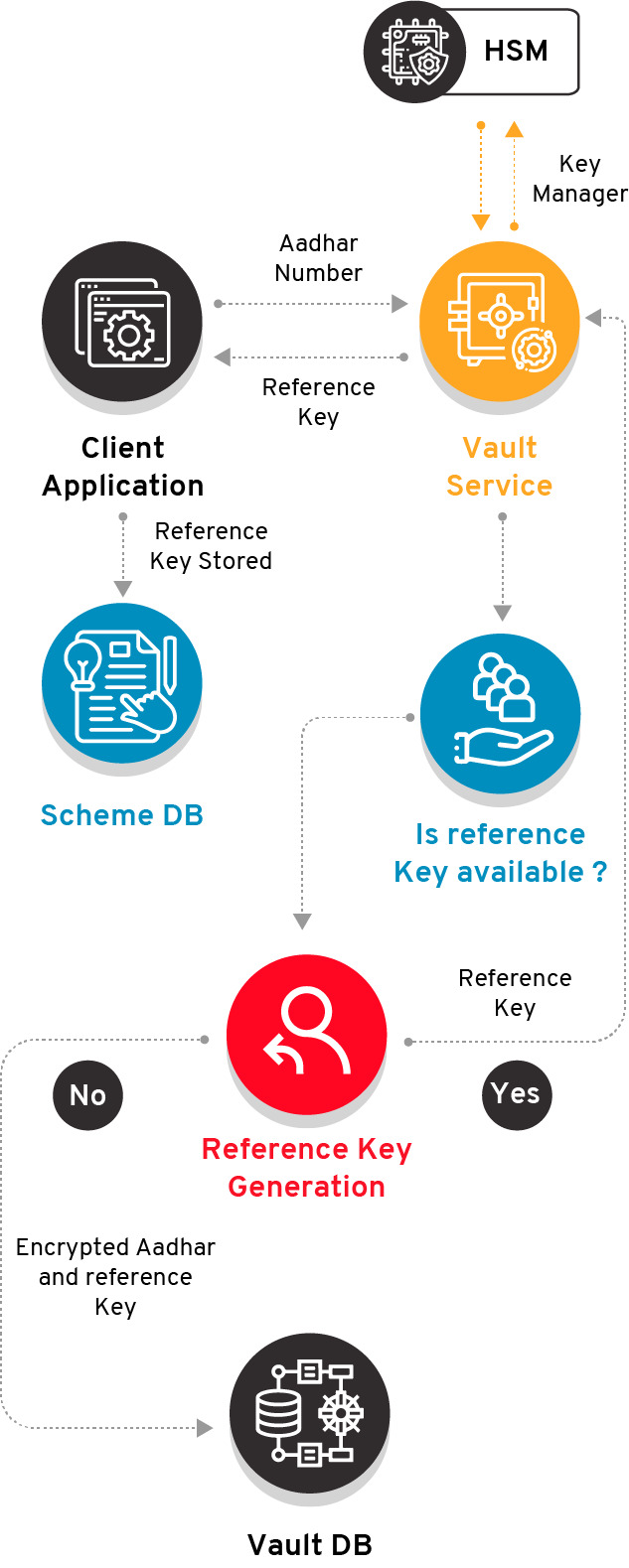
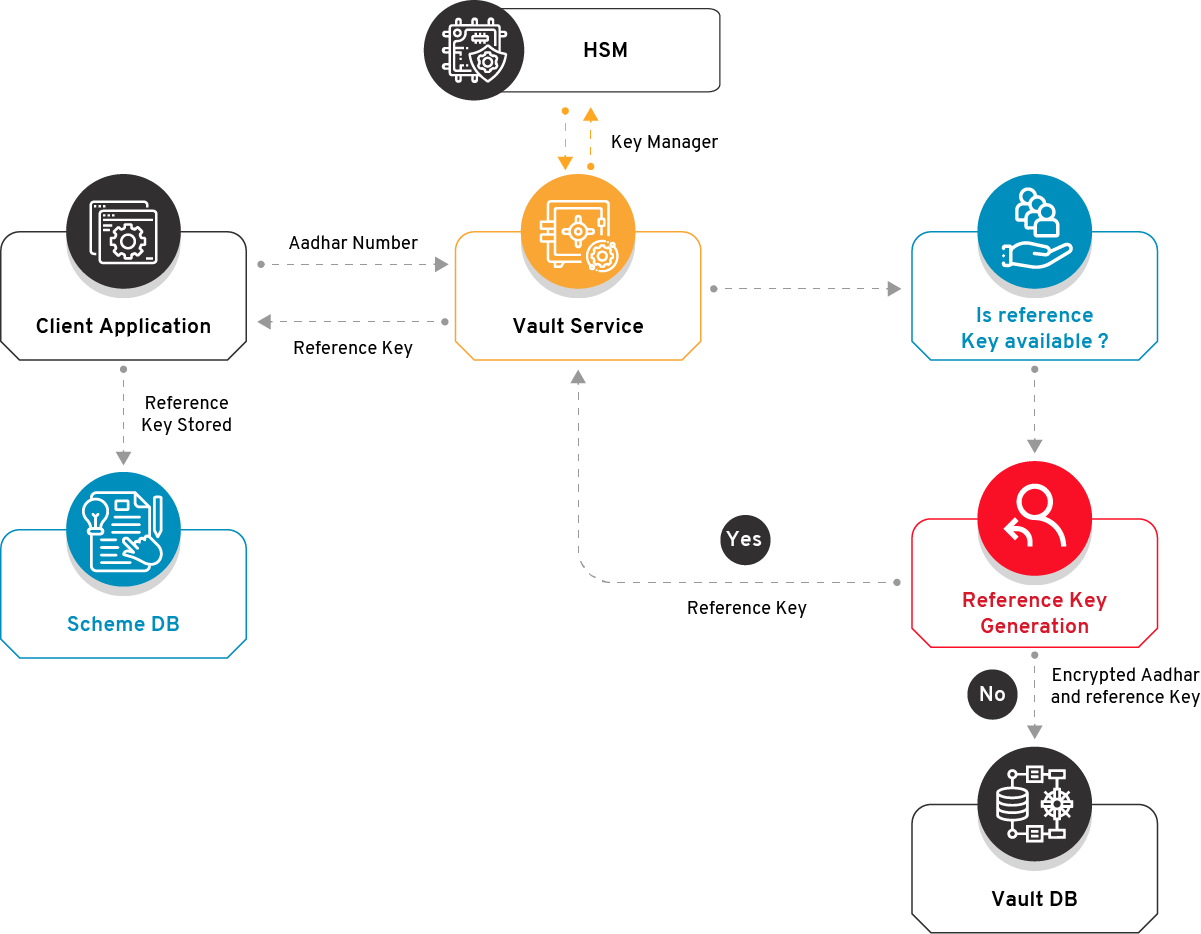
Aadhaar Data Vault introduces a secure abstraction layer between Aadhaar data and enterprise applications, ensuring that Aadhaar numbers and connected Aadhaar data are never directly exposed within operational systems.
- Aadhaar data is received through authentication or e-KYC for an approved purpose.
- Data is securely transmitted to the Aadhaar Data Vault via authorised vault services.
- Aadhaar number and connected Aadhaar data are encrypted and stored within the vault database.
- A unique reference key is generated and returned to the requesting application.
- Applications store and process only the reference key instead of the Aadhaar number.
- Any Aadhaar data access, where permitted, occurs only within secure vault boundaries and is fully logged and audited.
Deployment Models
As per UIDAI guidelines, organisations storing Aadhaar numbers and connected Aadhaar data are required to implement Aadhaar Data Vault in a manner that meets prescribed security, access control, and data protection mandates. While the compliance requirements are mandatory, UIDAI allows flexibility in how Aadhaar Data Vault is deployed, provided all regulatory and security expectations are met.
Aadhaar Data Vault therefore supports multiple deployment models to align with organisational IT policies, hosting preferences, and UIDAI compliance requirements.
- On-Premise Deployment: Deployed within the organisation’s own data centre, offering full control over infrastructure, security, and operations.
- Private Cloud / Government Community Cloud: Hosted in approved private or government cloud environments, ensuring scalability while meeting regulatory and security standards.
- Aadhaar Data Vault as a Service: A managed deployment model that enables faster compliance and easier integration, with logical data segregation and controlled access for AUAs, KUAs, and Sub-AUAs.
Applicability and Use Cases
As per UIDAI guidelines, Aadhaar Data Vault is mandatory for organisations that store full Aadhaar numbers and connected Aadhaar data for approved purposes. The requirement applies across government, public sector, and regulated private environments where Aadhaar is used for authentication, identification, or service delivery.
Accordingly, Aadhaar Data Vault is applicable across a wide range of Aadhaar-enabled and regulated systems, including:
- Government and Public Service Platforms: Government departments and e-Governance systems delivering citizen services using Aadhaar-based authentication.
- Welfare and Benefit Delivery Systems: Platforms supporting subsidies, pensions, scholarships, and other social welfare schemes.
- PFMS-Integrated Financial Workflows: Systems integrated with Public Financial Management System (PFMS) for fund disbursement and benefit transfers.
- Attendance and Workforce Management: Aadhaar-based attendance, payroll, and workforce monitoring systems.
- Banking and Regulated Financial Services: Banks, financial institutions, and other regulated entities using Aadhaar for identity verification and compliance.
- Telecom and Identity-Driven Platforms: Telecom operators and digital service platforms leveraging Aadhaar for subscriber verification and identity management.
Benefits of Aadhaar Data Vault
For organisations that are required to store Aadhaar numbers and connected Aadhaar data, Aadhaar Data Vault provides a secure, compliant, and future-ready foundation for Aadhaar-enabled systems. Beyond meeting mandatory UIDAI requirements, it delivers tangible security, operational, and governance benefits.
- Enhanced Aadhaar Data Privacy: Protects Aadhaar numbers and connected Aadhaar data through vault-based encryption and controlled access.
- End-to-End Aadhaar Data Security: Ensures secure handling of Aadhaar data at rest and in transit, supported by HSM-based cryptographic controls.
- Seamless UIDAI Compliance: Enables consistent adherence to UIDAI mandates related to Aadhaar storage, reference key usage, and auditability.
- Reduced Aadhaar Footprint Across Systems: Eliminates Aadhaar usage from operational databases by replacing it with reference keys, significantly lowering exposure risk.
- API-Driven System Integration: Supports easy integration with existing applications and platforms through secure, standards-based APIs.
- Automated Access Control and Key Management: Enforces role-based access, multi-factor authentication, and secure encryption key lifecycle management.
- Improved Auditability and Regulatory Transparency: Provides comprehensive logs and traceability to support audits, investigations, and compliance reviews.
- Lower Risk of Aadhaar-Related Fraud and Misuse: Minimises unauthorised access and misuse of Aadhaar data, reducing identity theft and fraud risks.
Strengthening Trust in Aadhaar-Enabled Digital Services
Aadhaar Data Vault is a key component of UIDAI’s broader data protection framework, designed to safeguard Aadhaar numbers and connected Aadhaar data while enabling secure, large-scale digital service delivery. By mandating vault-based storage and reference key–driven usage, UIDAI reinforces its commitment to protecting citizen data and strengthening trust in Aadhaar-enabled systems.
By implementing Aadhaar Data Vault, organisations can align with UIDAI’s data protection objectives, minimise Aadhaar data exposure, and ensure that digital services are delivered in a secure, compliant, and privacy-preserving manner.
CSM supports organisations in designing, implementing, and operating Aadhaar Data Vault solutions that meet UIDAI mandates and integrate seamlessly with existing systems, enabling compliant and resilient Aadhaar-enabled platforms.