

















Agriculture Doesn't Need More Data. It Needs Better Decisions.
Agriculture today generates more data than ever before.
Every farmer registration, land record, crop survey, weather update, subsidy disbursement, field inspection, and extension activity contributes to a growing digital footprint. Governments across the world have invested significantly in digitizing agricultural services, creating extensive databases and launching farmer-centric schemes.
Yet, one challenge continues to persist.
Most of this data exists in silos.
Different departments maintain different databases. Scheme information resides on separate platforms. Field reports often arrive days or weeks later. As a result, policymakers struggle to answer some of the most fundamental questions:
- Which farmers need immediate support?
- Which schemes are delivering the intended outcomes?
- Where are implementation gaps emerging?
- Which regions require timely intervention?
- How can limited resources be allocated for maximum impact?
In modern agriculture, the competitive advantage no longer lies in collecting data, it lies in transforming that data into decisions.
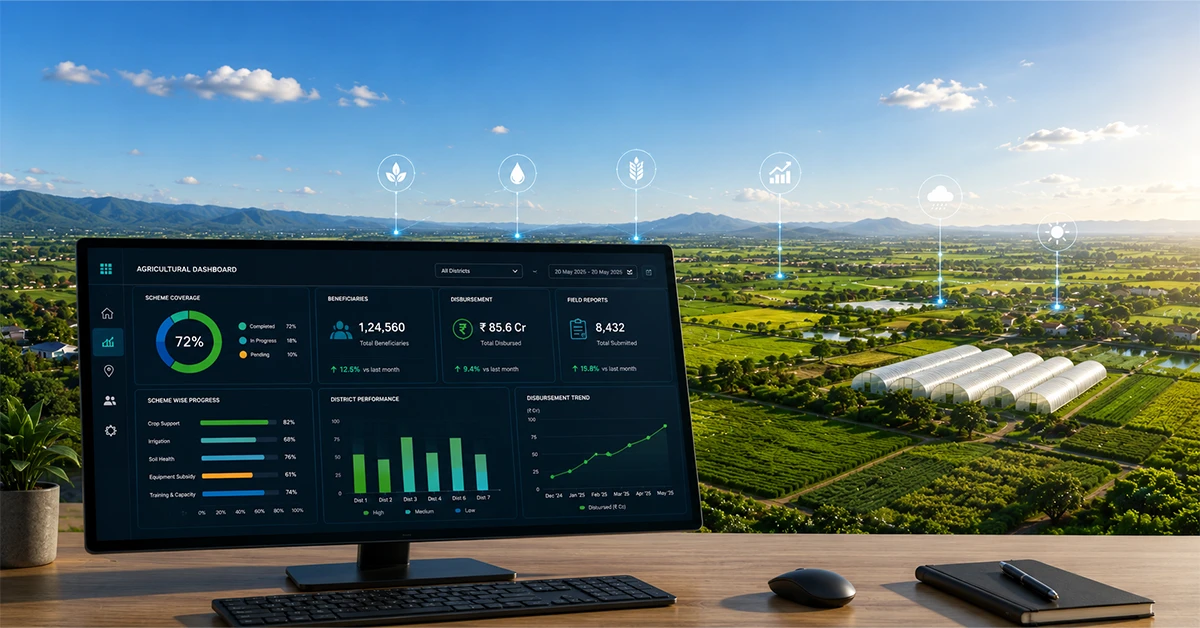
The Shift Towards Decision Intelligence
Around the world, governments are moving beyond digitization.
The focus is now shifting from building standalone applications to creating integrated intelligence ecosystems that enable evidence-based governance.
Across the globe, governments are recognizing that digital transformation is not about building more applications. It is about making existing systems work together. Countries are investing in integrated agricultural data ecosystems that combine farmer records, land information, satellite imagery, weather intelligence, and scheme data to support evidence-based policymaking. The European Union's CAP Monitoring System uses Earth observation data to monitor agricultural activities, while the United States Department of Agriculture (USDA) relies on integrated data platforms for crop forecasting, risk assessment, and programme planning. Australia's Digital Agriculture Strategy is similarly focused on creating connected digital ecosystems that enable smarter farming and better governance.
These global initiatives highlight a clear trend. The future of agricultural governance lies in unified decision intelligence platforms rather than isolated applications. A modern Decision Support System (DSS) embodies this shift by transforming scattered datasets into real-time insights through dashboards, GIS visualization, predictive analytics, and performance monitoring. This empowers governments to anticipate challenges, optimize resources, and move from reactive administration to proactive governance.
Why Governments Need an Integrated Agricultural DSS
Agricultural governance involves managing multiple stakeholders, numerous schemes, extensive field operations, and millions of beneficiary records.
Without an integrated platform, governments often face:
- Fragmented farmer and land databases
- Duplicate beneficiary records
- Delayed reporting from field offices
- Limited visibility into scheme implementation
- Manual compilation of performance reports
- Difficulty in measuring policy outcomes
- Challenges in identifying implementation gaps
An intelligent Decision Support System addresses these challenges by creating a unified digital ecosystem where every stakeholder works with verified, real-time information.
From Data Collection to Decision Intelligence
Agriculture generates vast amounts of data every day, from farmer registrations and land records to crop surveys, scheme benefits, field inspections, and financial assistance. The real challenge is not collecting this information but connecting it to create meaningful insights. This is where a modern Decision Support System (DSS) becomes the foundation of data-driven governance.
Creating a Single Source of Truth
A robust DSS brings together data from multiple sources into a unified repository, creating a comprehensive view of the agricultural ecosystem. Farmer profiles, land ownership records, crop details, scheme participation, field activities, financial assistance, and geospatial information are all integrated into a single platform. This unified view helps governments eliminate duplicate records, accurately identify beneficiaries, monitor implementation across administrative levels, analyse trends over time, and generate reliable reports without the delays of manual data compilation.
Bringing the Field Closer to Policymakers
Policies are only as effective as the information they are based on. By integrating mobile applications used by field officers, a DSS captures geo-tagged activities, beneficiary interactions, and implementation updates directly from the field. This continuous stream of verified, real-time data enables administrators to monitor ongoing activities, identify implementation bottlenecks, validate field execution, and respond swiftly to emerging challenges. As a result, policy decisions are guided by ground realities rather than assumptions.
Moving Beyond Monitoring to Decision Intelligence
Today's Decision Support Systems are much more than monitoring or reporting tools. They function as integrated decision intelligence platforms that combine real-time executive dashboards, GIS-enabled mapping, automated MIS reports, scheme performance analytics, KPI monitoring, beneficiary analysis, workflow automation, grievance management, predictive insights, and secure role-based access within a single ecosystem. With these capabilities, governments can continuously assess programme performance, optimize resource allocation, take timely corrective actions, and ensure that agricultural policies deliver measurable outcomes.
Better Decisions. Better Outcomes.
Imagine a farmer applying for government assistance after an unexpected crop loss. Instead of visiting multiple offices, submitting the same documents repeatedly, or waiting weeks for verification, the farmer is identified through a verified digital profile. Land records, eligibility, and scheme details are already available within a unified system, allowing support to reach faster and with greater accuracy.
Now, look at the same situation from the government's perspective. Decision-makers no longer have to rely on fragmented reports or outdated data to understand what's happening on the ground. They can see, in real time, which regions need immediate attention, how schemes are performing, where resources are being utilized, and whether intended beneficiaries are actually receiving support. Advanced analytics help identify implementation gaps, regional disparities, and emerging trends, enabling timely interventions and better policy planning.
When data flows seamlessly across the agricultural ecosystem, everyone benefits. Farmers receive timely, targeted services with fewer administrative hurdles, while governments gain the confidence to make evidence-based decisions, improve transparency, optimize public spending, and continuously refine schemes based on measurable outcomes. In the end, the true value of a Decision Support System lies not in the technology itself, but in its ability to ensure that every policy translates into meaningful impact on the ground.
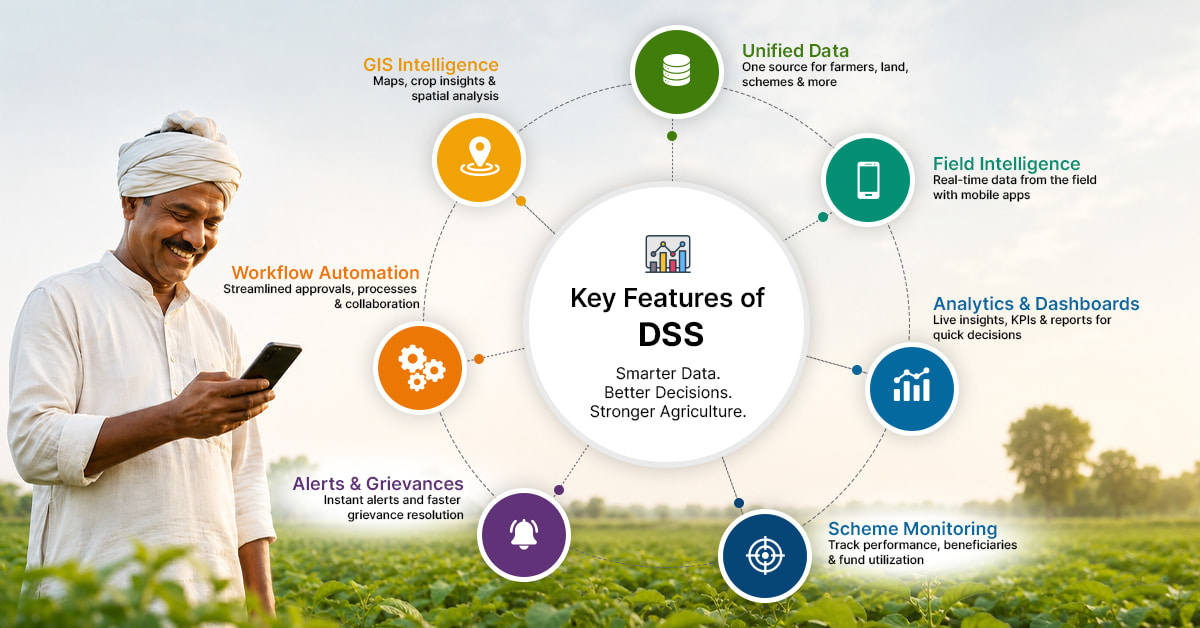
CSM's Approach to Agricultural Decision Intelligence
At CSM Technologies, we believe digital transformation is complete only when data translates into better governance outcomes.
Our Decision Support System is designed to unify agricultural data, field intelligence, analytics, and governance workflows into a single decision intelligence platform. By integrating verified beneficiary data, real-time field inputs, GIS intelligence, and advanced analytics, the platform empowers governments to move beyond reporting and embrace proactive, evidence-based policymaking.
The solution supports multi-level governance—from state headquarters to districts, blocks, and village administrations—enabling administrators to monitor schemes, assess outcomes, optimize resource allocation, and improve service delivery through actionable insights rather than fragmented information.
The Future of Agricultural Governance is Intelligent
The future of agriculture will not be defined solely by digital platforms but by the intelligence they generate.
As governments continue investing in Digital Public Infrastructure, AI, geospatial technologies, and integrated data ecosystems, Decision Support Systems will become the strategic foundation for planning resilient, transparent, and farmer-centric agricultural policies.
When every data point contributes to a better decision, governments become more responsive, programmes become more effective, and farmers receive the support they truly need.
That is the true promise of data-driven governance, and the direction in which agriculture is rapidly evolving.


Recent Publications




- Agriculture and Allied Services
- AgriTech
- Application Development
- Artificial Intelligence
- Blockchain
- COVID-19
- CSM Editorial
- Data Analytics
- Digital service
- Digital Transformation
- Education
- EduTech
- Emerging Technologies
- Enterprise Resource Planning
- Food Security
- Golden Records
- GovTech Solution
- Green Jobs
- Healthcare
- HR Analytics
- Hybrid Work Culture
- Independence Thought
- Industry 4.0
- Innovation
- IT Consulting
- Land & Industry
- Life@CSM
- Memory Lane
- Mines & Minerals
- Mining Technology
- Opinion Piece
- Precision Agriculture
- Smart City
- Social Listening
- Social Media
- Social Registry
- Super Apps
- Tourism
- User Experience
- Web 3.0
- Work Culture


















We will verify and publish your comment soon.