





















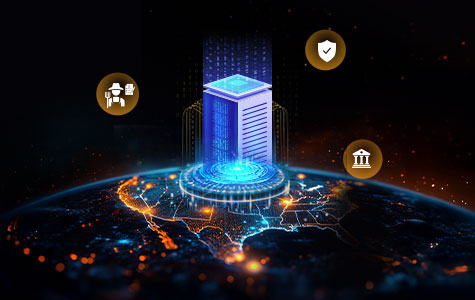
Every city has three layers most residents never think about: the foundation that keeps buildings standing, the building codes that decide what may be built on it, and the windows that let strangers see inside. Modern IT runs on the same three layers - except today, the windows are no longer optional. Security, compliance, and transparency have stopped being separate departments fighting for budget and become a single operating philosophy. Together, they are what turn a technology stack from a cost centre into a competitive edge.
.jpg)
Security: The Shift from Locked Doors to Living Defence
For two decades, security meant a wall - firewalls, passwords, an annual penetration test. That model assumed threats arrived from outside, on a schedule. Today's threat landscape doesn't keep office hours. Ransomware doesn't wait for the quarterly audit, and phishing doesn't announce itself.
The organizations winning this fight have stopped treating security as a gate and started treating it as a nervous system - sensing, signaling, and responding continuously. The urgency is hard to ignore. IBM's 2025 Cost of a Data Breach Report places the global average cost of a breach at US$4.4 million, while the average cost in India has climbed to a record ₹220 million (or Rs 22 crore). Organizations using AI-powered security and automation saved nearly US$1.9 million per breach through faster detection and containment.
Real-world leaders have already embraced this model. Microsoft embeds security engineering throughout its cloud ecosystem, while financial institutions such as JPMorgan Chase invest heavily in continuous threat intelligence and zero-trust architectures to defend mission-critical operations.
Compliance: From Paperwork to Strategic Radar
Compliance used to be a checklist completed once a year and filed away. That version of compliance is now a liability disguised as diligence. Frameworks like GDPR, HIPAA, ISO 27001, and the EU's Digital Operational Resilience Act don't just demand a clean record - they demand continuous visibility into how data moves, who touches it, and what happens when it doesn't behave.
.jpg)
The smartest enterprises have turned compliance into something closer to radar than paperwork. Consider global banks and healthcare providers that maintain real-time audit trails, automated policy controls, and software bills of materials (SBOMs) to satisfy regulators while accelerating innovation. In highly regulated sectors, compliance has become a growth enabler rather than a governance burden.
.jpg)
Building Digital Trust: How CSM Tech is Shaping the Future with Security, Compliance, and Transparency
In an era where digital trust has become the most valuable business currency, CSM Technologies empowers enterprises and governments with IT solutions that are secure by design, compliant by default, and transparent by intent.
Our cybersecurity and data security frameworks are engineered to safeguard critical digital assets through continuous monitoring, multi-layered access controls, Single Sign-On (SSO), audit trails, and resilient cloud architectures. Whether managing enterprise systems, public digital infrastructure, or IoT-enabled ecosystems, CSM ensures proactive protection against evolving cyber threats while maintaining uninterrupted operations.
Beyond security, CSM enables organizations to stay ahead of increasingly complex regulatory requirements. Solutions such as CSM Docovault provide centralized, secure, and compliant document management, while our governance-driven platforms align seamlessly with regulatory mandates, data governance frameworks, and organizational accountability standards.
What truly differentiates CSM is our commitment to transparency. From explainable AI models with human oversight to paperless workflows that create immutable digital trails, we help organizations build trust into every transaction and decision. Solutions like CSM cSigner further strengthen this trust by ensuring legally valid, tamper-proof digital documentation.
At CSM Technologies, we don't just deliver technology solutions—we build trusted digital ecosystems that enhance security, ensure compliance, foster transparency, and accelerate sustainable growth in a rapidly evolving digital world.
Transparency: The New Proof of Trust
If security is the foundation and compliance is the code, transparency is the glass wall. As AI quietly makes more decisions inside organizations — credit approvals, hiring shortlists, fraud flags - opacity has become indistinguishable from risk.
The numbers are revealing. A recent industry survey found that 95% of organizations do not fully trust their cybersecurity vendors, citing insufficient transparency and accountability. Meanwhile, experts increasingly argue that operational proof—not compliance paperwork will determine whether AI systems are trustworthy.
Leading organizations are responding accordingly. Salesforce publishes detailed AI trust and governance frameworks, while financial regulators increasingly require explainable AI and auditable decision trails before approving automated systems.
Transparency, in this light, isn't generosity. It's evidence. An organization willing to show its audit trails, its data flows, and its AI's reasoning is making a quiet but unmistakable claim: we have nothing to hide because we have everything under control.
The Uncomfortable Truth
Here's the part most vendors won't say out loud: treating security, compliance, and transparency as three separate checkboxes is itself the vulnerability. Fragmented ownership creates blind spots, and blind spots are exactly where breaches, fines, and reputational damage live.
IBM's research found that 63% of organizations still lack formal AI governance policies, while 97% of AI-related security incidents occurred where proper AI access controls were absent. The lesson is clear: governance, security, and transparency must evolve together.
.jpg)
A Vision for What's Next
The next era of IT won't reward the loudest security claims or the thickest compliance binders. It will reward systems that can prove, in real time, that they are safe, lawful, and honest - all at once, without being asked twice.
Security will keep getting quieter and smarter. Compliance will keep getting faster and more automated. And transparency will stop being a feature and start being the price of entry.
The organizations that internalize this now won't just avoid the next breach or the next fine. They'll be the ones customers, regulators, and partners instinctively trust first — because trust, in the digital economy, has finally become a measurable asset.
Ready to build IT infrastructure that's secure by design, compliant by default, and transparent by choice? The conversation about your organization's risk posture is best started before the audit, not after the breach.
After all, in tomorrow's IT, the one thing you can't afford to leave unencrypted is your integrity.


Recent Publications





- Agriculture and Allied Services
- AgriTech
- Application Development
- Artificial Intelligence
- Blockchain
- COVID-19
- CSM Editorial
- Data Analytics
- Digital service
- Digital Transformation
- Education
- EduTech
- Emerging Technologies
- Enterprise Resource Planning
- Food Security
- Golden Records
- GovTech Solution
- Green Jobs
- Healthcare
- HR Analytics
- Hybrid Work Culture
- Independence Thought
- Industry 4.0
- Innovation
- IT Consulting
- Land & Industry
- Life@CSM
- Memory Lane
- Mines & Minerals
- Mining Technology
- Opinion Piece
- Precision Agriculture
- Smart City
- Social Listening
- Social Media
- Social Registry
- Super Apps
- Tourism
- User Experience
- Web 3.0
- Work Culture

















We will verify and publish your comment soon.