




















India manages roughly 1,137 BCM of utilizable water annually, and almost every decision about how that water moves, where it goes, and when it's released traces back to reservoir storage data. For a country where agriculture supports 1.4 billion people, where hydropower anchors grid stability, and where urban supply depends on seasonal monsoon cycles, the quality of that data is not just operational. It is foundational to governance.
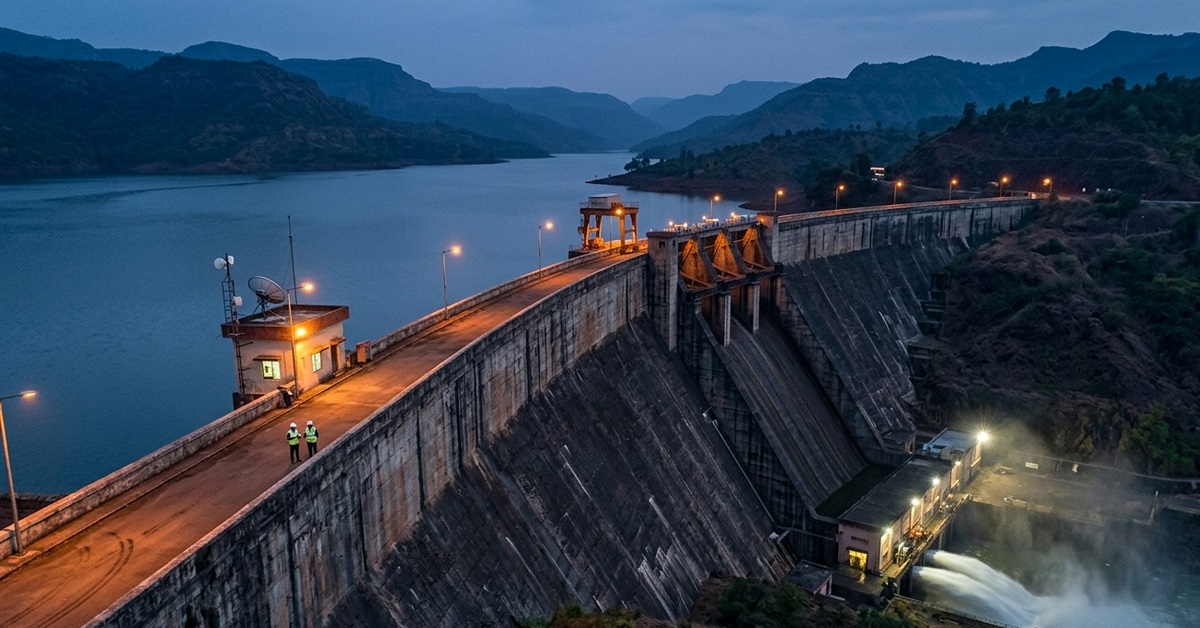
In 2025, the Ministry of Jal Shakti took the initiative to introduce the web-based RSMS Portal, marking a significant step in digitizing national reservoir monitoring. Developed in collaboration with the Central Water Commission (CWC), India’s apex technical authority for water resources, the platform reflects a shift in how reservoir intelligence is generated, validated, and used.
The Gaps That Shaped the System
CWC’s monitoring mandate spans 166 reservoirs across 5 regions and 13 river basins, representing 178.8 BCM of live storage capacity. This network simultaneously supports irrigation, hydropower, and drinking water systems, making storage position a shared input across sectors.
At this scale, the challenge was not the absence of data, but the way it moved. Reservoir readings originated at dispersed field points and travelled through administrative layers before forming a national view. Validation typically occurred during report preparation rather than at entry. Historical data existed, but across formats that limited comparison. The national storage picture aligned more closely with reporting cycles than with real-time conditions.
A shortfall signal that arrives late does not just delay action. It compresses the response window for multiple sectors at once.
Reframing the Data Flow, Not Just Digitizing It
The Reservoir Storage Monitoring System (RSMS), implemented with CSM Technologies as the technology partner, brings this process into a single, governed workflow. It links field-level data entry, regional review, and central oversight within a defined structure of roles and accountability.
The shift is not just digital. It is structural.
Instead of reworking the entire process, the system changes how key points in the data lifecycle behave:
- Validation moves to the point of entry: Reservoir data is checked against physical thresholds such as MWL, FRL, and MDDL, and flagged for abnormal variation before it becomes part of the central dataset. This reduces reliance on downstream correction.
- Incomplete data no longer breaks analysis: Missing values are computed using reservoir-specific elevation–capacity relationships. This allows datasets to remain continuous and decision-ready even when inputs are partial.
- Historical data becomes an active reference layer: Multi-year storage records, spanning over a decade, are now structured for comparison. This enables current storage to be read against seasonal patterns and long-term trends.
- Reporting is generated, not compiled: The weekly reservoir bulletin is produced directly from validated system data. Outputs therefore reflect the most recent state rather than a manually consolidated view.
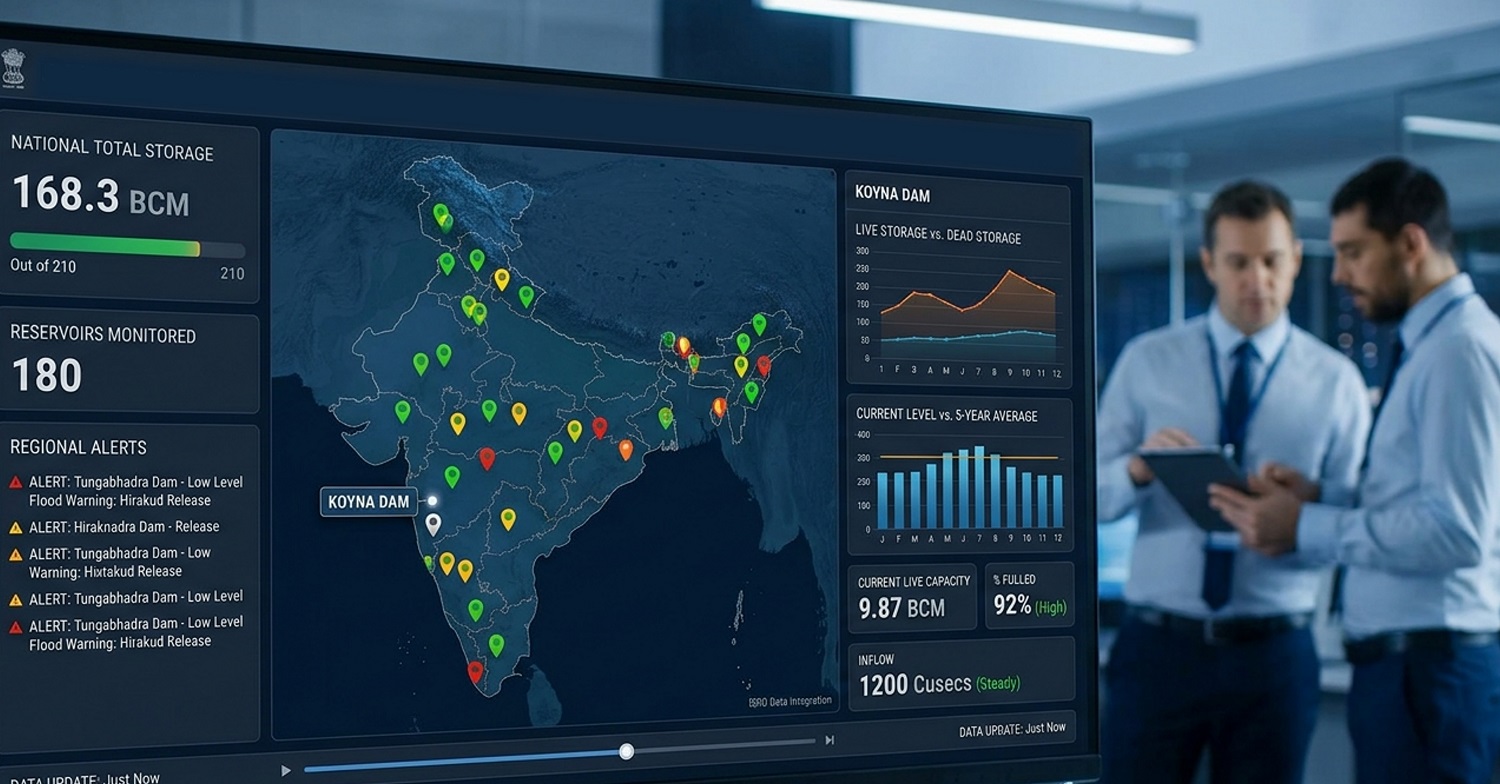
- Advisories are condition-driven, not manually triggered: Drought signals are issued only when defined thresholds are breached, such as storage falling below both last year’s level and long-term averages. This ensures consistency in how alerts are raised.
When Reporting Reflects the System, Not the Process
The weekly reservoir bulletin continues to remain central, but its role changes.
Instead of being compiled manually, it is generated directly from validated system data. This ensures that what is reported reflects the latest available state. Similarly, advisory signals are governed by clearly defined conditions. For instance, drought alerts are triggered only when storage falls below both the previous year’s level and the long-term average.
This reduces subjectivity in interpretation and ensures that signals are both consistent and timely.
In this structure, reporting no longer defines visibility. It reflects it.
Extending the System to Where Data Begins
Another shift lies in how closely the system operates to the point of data generation.
With mobile-based access and offline capability, reservoir-level operators can enter and review data directly from the field, with synchronization once connectivity is restored. This reduces dependency on relay-based reporting and shortens the distance between observation and system visibility.
At the same time, role-based access and audit trails ensure that every entry, edit, and correction remains traceable. This is an essential requirement in a system where data informs decisions across sectors.
From Periodic Reporting to Continuous Awareness
What emerges is not just a faster reporting system, but a more reliable way of understanding reservoir behaviour at scale.
Monitoring shifts from a cycle-driven exercise to a continuous, system-level view. Validation happens earlier, datasets remain usable even when incomplete, and historical context actively informs current conditions. Today, this enables continuous visibility across a network of 166 reservoirs, where a single storage signal can influence multiple decisions simultaneously.
In doing so, it moves reservoir monitoring closer to what it was always meant to support. That is timely, informed, and defensible decision-making, with system design grounded in domain understanding and operational alignment, as reflected in its implementation with CSM Technologies as the technology partner.
In that sense, the shift is not just in technology. It is in how data systems are designed to inform decisions when they matter most.
The Beginning of a Data-Driven Water Future
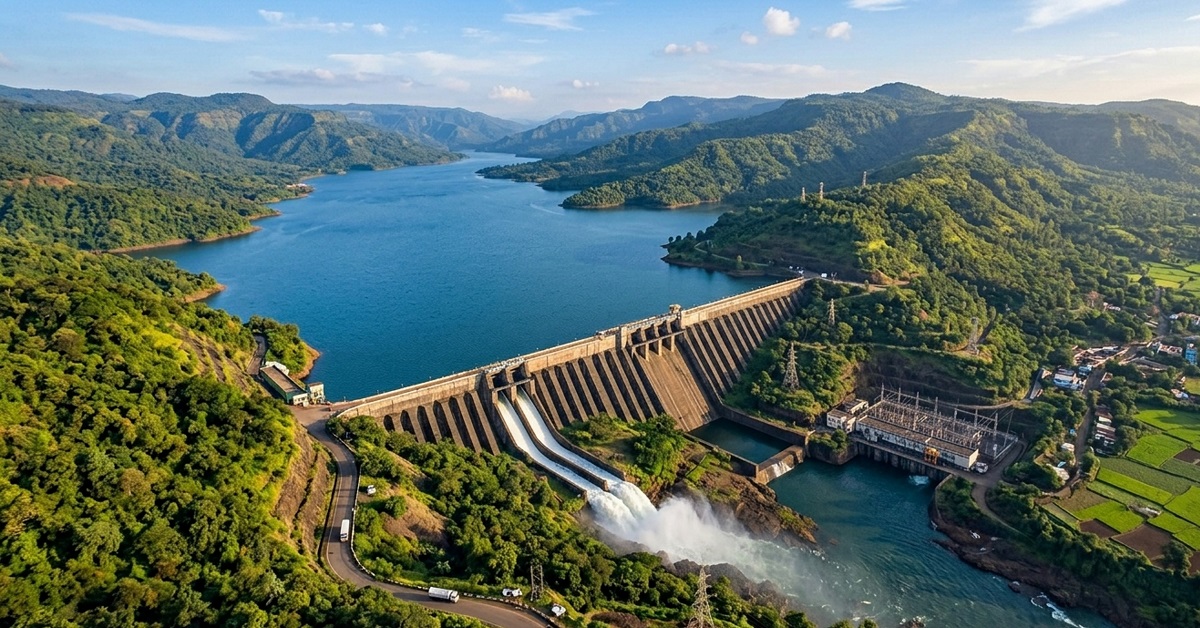
The evolution of RSMS signals a broader shift in governance thinking.It recognizes that in complex, interdependent systems like water, data must not only exist—it must perform.
By aligning system design with operational realities and domain knowledge, reservoir monitoring is moving closer to its true purpose: enabling timely, informed, and defensible decisions at scale.
This is what defines the new era of water governance.
Not just more data—but real-time intelligence that matters when it matters most.


Recent Publications






- Agriculture and Allied Services
- AgriTech
- Application Development
- Artificial Intelligence
- Blockchain
- COVID-19
- CSM Editorial
- Data Analytics
- Digital service
- Digital Transformation
- Education
- EduTech
- Emerging Technologies
- Enterprise Resource Planning
- Food Security
- Golden Records
- GovTech Solution
- Green Jobs
- Healthcare
- HR Analytics
- Hybrid Work Culture
- Independence Thought
- Industry 4.0
- Innovation
- IT Consulting
- Land & Industry
- Life@CSM
- Memory Lane
- Mines & Minerals
- Mining Technology
- Opinion Piece
- Precision Agriculture
- Smart City
- Social Listening
- Social Media
- Social Registry
- Super Apps
- Tourism
- User Experience
- Web 3.0
- Work Culture


















We will verify and publish your comment soon.