





















Just imagine, a farmer in a remote district checks his subsidy status on a phone. A first-generation entrepreneur registers a company without setting foot in the government office. A government owned hospital in a small town receives drug inventory alerts in real time. A government official verifies and approves a residential building permit from her laptop.
None of this sounds remarkable anymore. And that, in itself, is remarkable. What once required days of queuing, stacks of paper, and visits across multiple government counters has quietly shifted into digital interactions that take minutes. The infrastructure making all of this possible has a name: GovTech.
This is the complete story of GovTech: what it is, where the term came from, which countries made it famous, how large it truly is, and most importantly why it may well be the most consequential technology sector of the next decade.

What Exactly Is GovTech?
At its core, GovTech, short for Government Technology, refers to the use of digital technologies to improve how governments operate and how public services are delivered to citizens and businesses. But that definition, while accurate, does not quite capture the scale or ambition of what GovTech has become.
The World Bank, which has done more than any other institution to formalize and define the concept, describes GovTech as a whole-of-government approach to public sector modernization, one that promotes simple, efficient, and transparent government with the citizen at the center of reforms. (Source: World Bank GovTech Guidance Note, 2021)
What makes GovTech distinct from older notions of e-government or government IT is the scope of that commitment. Earlier phases of digital government focused on digitizing individual processes: putting a form online, creating a department portal, enabling electronic filings. GovTech, by contrast, asks a more systemic question: how can technology transform the entire machinery of governance, from the inside out?
This is the difference between a government that has an app and a government that is, fundamentally, a digital institution.
What is GovTech
"GovTech is a whole-of-government approach to public sector modernization and promotes simple, efficient and transparent government with the citizen at the center of reforms." — World Bank
How the Term Was Coined and Why It Matters
The term GovTech did not emerge from a single eureka moment. It evolved from parallel efforts across governments, multilateral organizations, and technology communities over roughly two decades.
The foundational vocabulary, including e-government, digital governance, and government IT, had been in use since the early 2000s as countries built basic online portals and digital record systems. But these terms described isolated projects rather than a strategic vision.
The shift came decisively in 2019, when the World Bank's Governance Global Practice formally launched the GovTech Global Partnership (GTGP), established in collaboration with the governments of Switzerland, Austria, and South Korea. The GTGP was not just a funding initiative. It was a formal acknowledgment that digital government had entered a new and more ambitious phase. GovTech, the World Bank declared, represented the current frontier of government digital transformation. (Source: World Bank GovTech Global Partnership)
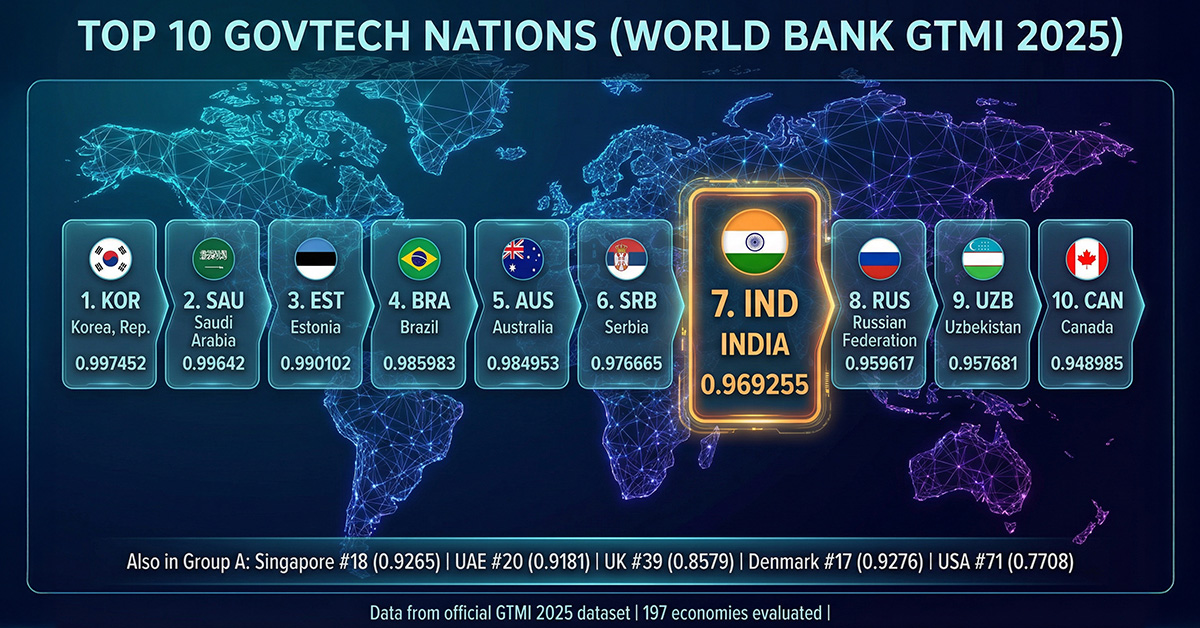
That framing mattered. It gave governments, development institutions, investors, and technology firms a shared vocabulary and a shared benchmark. The World Bank's GovTech Maturity Index, which evaluates digital government progress across 198 economies, became the closest thing the sector has to a global scoreboard.
Around the same time, a parallel signal was coming from the startup and investment community. Private capital began flowing into companies building technology specifically for government use: permitting platforms, civic engagement tools, digital identity systems, and public procurement automation. Investors and founders needed a term for this emerging category. GovTech filled that space.
Today, the term is used consistently across the World Bank, the World Economic Forum, the United Nations, and dozens of national governments. Its rise from technical jargon to mainstream policy language in less than a decade is, itself, a measure of how fast the sector has moved. (Source: ISACA Journal, The Future of GovTech, 2022)
The Countries That Made GovTech Famous
Estonia: The Nation That Chose to Be Digital
Any honest telling of the GovTech story must begin in Estonia. With a population of just 1.3 million, roughly the size of a large Indian city, Estonia became the first country in the world to achieve 100 percent of government services available online, a milestone reached in December 2024. (Source: ComplexDiscovery, Finally 100% Digital, 2025)
The journey began in the 1990s, when Estonia emerged from Soviet rule with almost no legacy bureaucratic infrastructure. Rather than building the paper-based systems other countries were trying to digitize, Estonia chose to go digital from the start. The decision was driven partly by necessity and partly by an extraordinary concentration of political will and technical ambition.
The backbone of Estonia's digital government is X-Road, a secure data exchange platform launched in 2001. X-Road allows every public institution's IT systems to communicate with each other without creating a central data repository, a design choice that protects privacy while enabling seamless service delivery. Today, X-Road connects over 929 institutions, supports more than 3,000 digital services, and processes over three billion data queries per year. (Source: Future Shift Labs, X-Road Technology)
Estonia: 99% of public services available online 24/7 | 30% of votes cast digitally | X-Road processes 3 billion+ queries per year and has saved an estimated 2,589 working years in a single calendar year | Ranked 2nd globally, UN E-Government Survey 2024>
An Estonian citizen can file taxes in under three minutes, start a company in under fifteen, and vote from anywhere in the world. They can also see exactly who has accessed their personal data and why, a transparency guarantee embedded in the system's architecture. (Source: Invest in Estonia)
Estonia's e-Residency program extended this logic globally. Over 130,000 entrepreneurs from around the world hold Estonian digital residency, using it to incorporate and manage EU-based companies entirely online. (Source: e-Residency, 11 Firsts from Estonia)
Singapore: The Country That Named Its IT Department GovTech
Singapore offers a different but equally instructive model. Where Estonia started fresh, Singapore built its digital government on decades of systematic, state-directed planning. And where Estonia is celebrated as a scrappy innovator, Singapore is the institutional architect.
In 2016, Singapore established the Government Technology Agency, formally named GovTech, as a statutory board under the Prime Minister's Office. The naming was deliberate and significant. By calling its national digital agency GovTech, Singapore signalled that government technology was not a support function. It was a strategic priority at the heart of national governance. (Source: GovTech Singapore, Our Story)
GovTech Singapore develops, manages, and secures the entire digital infrastructure of the Singaporean state. Its flagship product, Singpass, is Singapore's national digital identity platform.
Over five million users across Singapore use Singpass to authenticate across more than 2,700 government and private sector services, from checking CPF balances and booking medical appointments to renewing insurance. The platform facilitates over 41 million transactions every month. (Source: GovTech Singapore, Singpass product page)
Singpass: 5 million users | 2,700+ services across 800 government agencies and businesses | 41 million+ transactions every month
During the COVID-19 pandemic, GovTech Singapore demonstrated what a mature digital government infrastructure enables. Digital tools for contact tracing, health declarations, and benefit disbursements were deployed at national scale within weeks, built on identity, payment, and data infrastructure that had been systematically constructed over years.
GovTech Singapore has since become a reference model studied by delegations from around the world. Nations from Abu Dhabi to Malaysia have visited Singapore to understand its approach: a pragmatic, security-conscious, citizen-centered philosophy of building digital services one platform at a time. (Source: Grokipedia, Government Technology Agency entry)
Other Pioneers Worth Naming
South Korea topped the World Bank's GovTech Maturity Index with a near-perfect score of 0.999 out of 1, leading in core government systems, digital service delivery, and GovTech enablers. (Source: Korea-EU Research Centre, Korea tops World Bank index — k-erc.eu)
The United Kingdom's Government Digital Service (GDS), established in 2011, pioneered the concept of government as a platform and influenced a generation of digital government reformers worldwide. (Source: UK Government Digital Service)
In the developing world, Rwanda's IremboGov platform now gives citizens access to over 247 digital government services from 38 institutions, and has saved Rwandans more than 120 million hours previously spent traveling to government offices. Service delivery times dropped from five days to 24 hours. (Source: Rwanda Dispatch, Irembo Platform Transforms Access, 2025)
Brazil, Saudi Arabia, and the United Arab Emirates have invested heavily and risen to the top tier of the World Bank's GovTech Maturity rankings. Malaysia has made GovTech a central pillar of its ambition to become a high-income digital economy by 2030. (Source: WEF, The Global Public Impact of GovTech, 2025)
How Big Is GovTech? Numbers That Put It in Perspective
Here is a number that tends to stop conversations: according to the World Economic Forum, the global GovTech market stood at approximately $606 billion in 2024. By 2034, the WEF projects it will more than double to $1.42 trillion. And beyond market size, the WEF estimates that GovTech could unlock $9.8 trillion in total public value over the same period, through efficiency gains, anti-corruption impact, and sustainability improvements. (Source: WEF, The Global Public Impact of GovTech, January 2025)
Global GovTech Market 2024: approx. $606 billion | Projected 2034: $1.42 trillion | Projected total public value unlocked by 2034: $9.8 trillion (World Economic Forum, 2025)

These numbers reflect something important: governments are, collectively, the largest technology buyers in the world. The GovTech market is not a niche vertical sitting alongside mainstream technology industries. It is already one of the biggest single verticals in global technology spending.
In the United States alone, state and local governments allocate over $103 billion annually to IT systems. (Source: Industry Research, Gov Tech Market Analysis)
India's Union Budget for 2025-26 allocated Rs 26,026.25 crore to the Ministry of Electronics and Information Technology (MeitY), an 18.64 percent increase over the previous year's budget estimates. (Source: Internet Freedom Foundation, 2025 Budget and Digital Rights)
To understand the scale of that Indian figure: Rs 26,026 crore is approximately $3.1 billion USD. That figure covers only the central ministry. State governments, the National Informatics Centre, the Unique Identification Authority of India, and dozens of mission-specific digital programs carry separate allocations of their own. Put together, India's annual public digital infrastructure expenditure runs into tens of billions of dollars, dwarfing the IT budgets of most-large private corporations.
A single ministry's annual digital budget in India is larger than the IT spend of most Fortune 500 companies. GovTech is not a niche. It is the mainstream.
The GovTech sector globally employs over 497,000 workers, with more than 4,150 companies operating in the space. Major industry hubs have formed in the United States, India, Germany, the United Kingdom, and Italy, with city-level clusters in London, Pune, New Delhi, Washington D.C., and Bangalore. (Source: StartUs Insights, GovTech Outlook 2025)
India's GovTech Story: Scale Like Nowhere Else
India deserves its own chapter in any GovTech narrative, not because it is the most polished implementation, but because it represents something no other country has achieved: GovTech at true population scale.
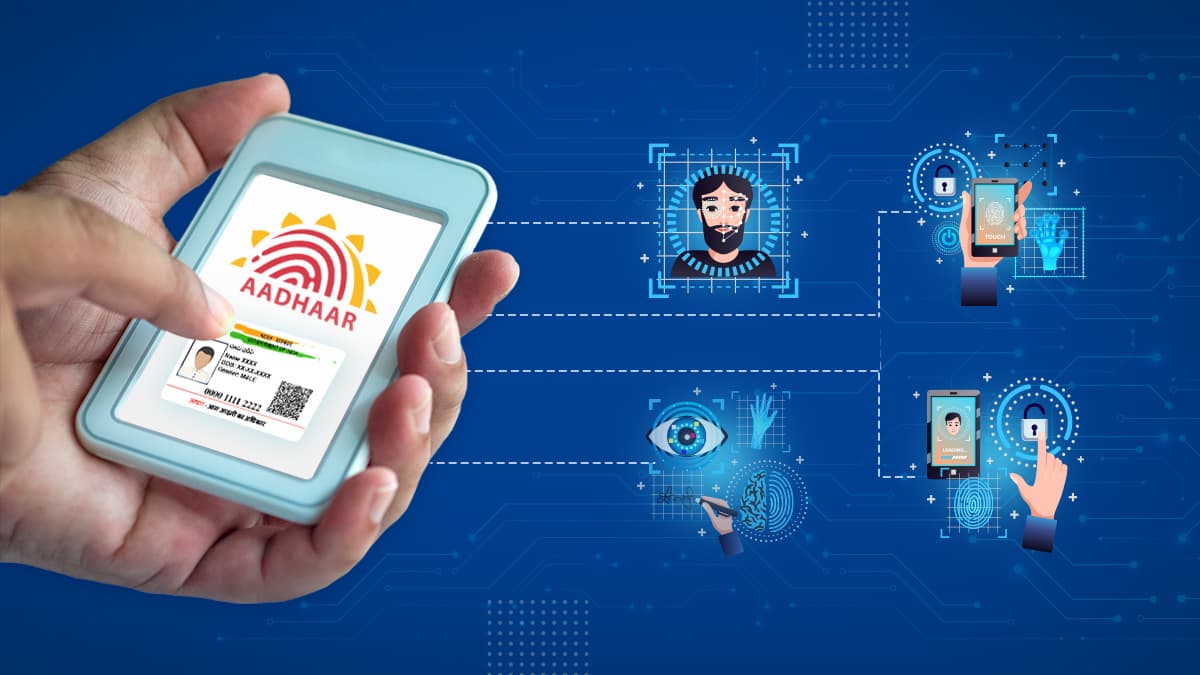
Over the past decade, India has built a set of digital public infrastructure systems, collectively known as India Stack, that are among the most consequential technology projects in human history. Aadhaar, India's biometric digital identity system administered by the Unique Identification Authority of India, has generated over 142 crore ID registrations as of April 2025. (Source: Press Information Bureau, Ten Years of Digital Progress)
The Unified Payments Interface (UPI), built by the National Payments Corporation of India, has made India the world leader in real-time digital payments. As of 2023, India processed 49 percent of all global real-time transactions. In April 2025 alone, over 1,867 crore UPI transactions worth Rs 24.77 lakh crore were conducted. Nearly 460 million people and 65 million merchants transact through UPI, and the system now operates in over seven countries. (Source: Press Information Bureau, Ten Years of Digital Progress)
India: 142 crore+ Aadhaar IDs generated | 49% of global real-time payments processed through UPI | Rs 44 lakh crore transferred via Direct Benefit Transfer since inception | World Bank GTMI: Group A (Extensive Growth Maturity)
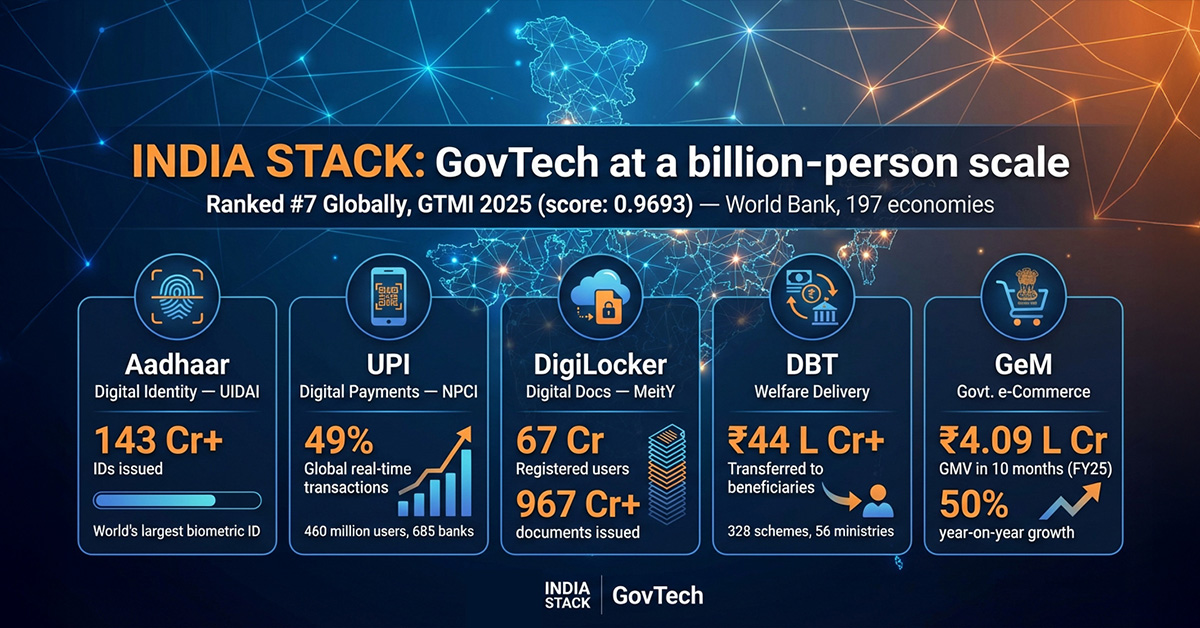
India's Direct Benefit Transfer system has used this digital infrastructure to transform welfare delivery, eliminating ghost beneficiaries, removing intermediaries, and ensuring subsidies reach intended recipients directly. Between 2015 and March 2023, DBT saved the Indian government over Rs 3.48 lakh crore, while more than 5.87 crore ineligible ration cards and 4.23 crore duplicate LPG connections were cancelled. (Source: Press Information Bureau, Ten Years of Digital Progress)
The World Bank's GovTech Maturity Index places India in Group A, the highest category of Extensive Growth Maturity, recognizing the depth and scale of India's digital government transformation. India's digital economy contributed 11.74 percent of national income in 2022-23 and is projected to reach nearly one-fifth of the total economy by 2030. (Source: ICRIER Prosus Centre, State of India's Digital Economy Report 2024)
India's GovTech ambition continues to expand. The IndiaAI Mission, approved in March 2024 with a budget of Rs 10,371.92 crore over five years, aims to build India into a global leader in AI research and deployment, including within the public sector. The Government e-Marketplace (GeM) recorded a Gross Merchandise Value of Rs 4.09 lakh crore in just ten months of FY 2024-25, a nearly 50 percent growth year on year. (Source: Press Information Bureau, Ten Years of Digital Progress)
What Comes Next for GovTech
GovTech is at an inflection point. The first wave was about digitization: moving paper processes online. The second wave was about integration: connecting systems across departments and agencies. The wave now underway is about transformation: using artificial intelligence, data analytics, and shared digital infrastructure to make government genuinely intelligent and proactive.
The World Bank's GovTech Global Partnership has established dedicated working groups focused on AI in the public sector, cloud computing, digital identity, and citizen engagement. At the World Economic Forum's annual meeting in Davos in January 2025, a panel titled Reimagining Governance: The Next Frontier in GovTech brought together heads of government, technology leaders, and development institutions. (Source: WEF, Can GovTech Deliver in the Intelligent Age, January 2025)
The challenges are real. Legacy systems in many countries remain deeply entrenched. Digital divides persist between urban and rural populations, and between those with digital literacy and those without. Data privacy and cybersecurity concerns require constant vigilance. Estonia itself was the target of one of the world's first major state-sponsored cyberattacks, in 2007, and has been among the most persistently targeted countries globally ever since.
But the direction is clear. Governments that invest in digital infrastructure today are building the capacity to deliver faster, more equitable, more transparent, and more resilient public services for decades ahead. Those that delay are already falling behind the expectations citizens bring from their experiences in the private sector.
Building GovTech in Practice
The transformation described in this article does not happen through policy announcements alone. It requires deep technical expertise, domain knowledge, and sustained delivery capability across sectors. That is where specialized GovTech firms play an essential role.
CSM Technologies, headquartered in Bhubaneswar, Odisha, has spent over 28 years building precisely this kind of expertise. Founded in 1998 and now operating across India, Africa, and North America, CSM has contributed to GovTech implementations spanning agriculture, mining, education, healthcare, urban governance, and public administration, working as a technology partner to governments designing systems that serve real populations at scale.
The work of building GovTech is, in many ways, a continuation of what the public sector has always tried to do: serve citizens effectively and accountably. The technology changes. The commitment does not.


Recent Publications




- Agriculture and Allied Services
- AgriTech
- Application Development
- Artificial Intelligence
- Blockchain
- COVID-19
- CSM Editorial
- Data Analytics
- Digital service
- Digital Transformation
- Education
- EduTech
- Emerging Technologies
- Enterprise Resource Planning
- Food Security
- Golden Records
- GovTech Solution
- Green Jobs
- Healthcare
- HR Analytics
- Hybrid Work Culture
- Independence Thought
- Industry 4.0
- Innovation
- IT Consulting
- Land & Industry
- Life@CSM
- Memory Lane
- Mines & Minerals
- Mining Technology
- Opinion Piece
- Precision Agriculture
- Smart City
- Social Listening
- Social Media
- Social Registry
- Super Apps
- Tourism
- User Experience
- Web 3.0
- Work Culture



















We will verify and publish your comment soon.