




















AI capability is no longer the bottleneck. Most institutions as of now can deploy models, automate workflows, and develop dashboards in months, sometimes weeks. Vendors deliver what was scoped. Early metrics look healthy. Leadership sees movement.
Then adoption flattens. The system runs. Reports are generated. Alerts trigger correctly. Nothing is technically broken.
Yet parallel spreadsheets return. Informal calls regain importance. Approvals slow down rather than accelerate. What’s happening is not a model failure. It’s a context failure.
Most AI deployments follow a predictable trajectory in which systems work as designed, yet adoption quietly stalls especially across large Government Technology ecosystems where institutional realities shape implementation outcomes.
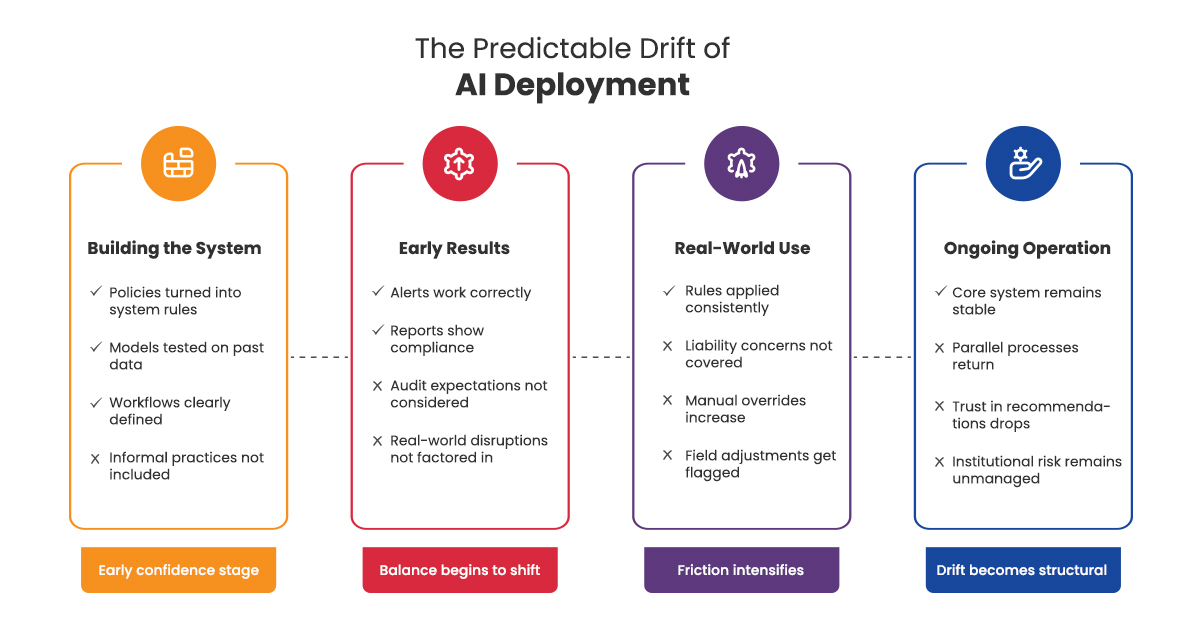
Where Deployments Quietly Drift
In a recent review of a regulatory approval engine, every rule had been mapped directly to policy text. The architecture was clean. Escalations were defined. Exception pathways were technically sound.
Within three weeks of rollout, officers were overriding recommendations in nearly 30% of cases. The reason wasn’t resistance to technology. It was liability exposure.
One specific edge case, carried consequences that no automated recommendation could absorb. The workflow assumed policy sufficed. The officers knew audit interpretation often differs from policy wording. They optimized accordingly.
The system enforced compliance logic. The humans managed institutional risk. That distinction was never encoded.
When Correct Data Isn’t Also Not Enough
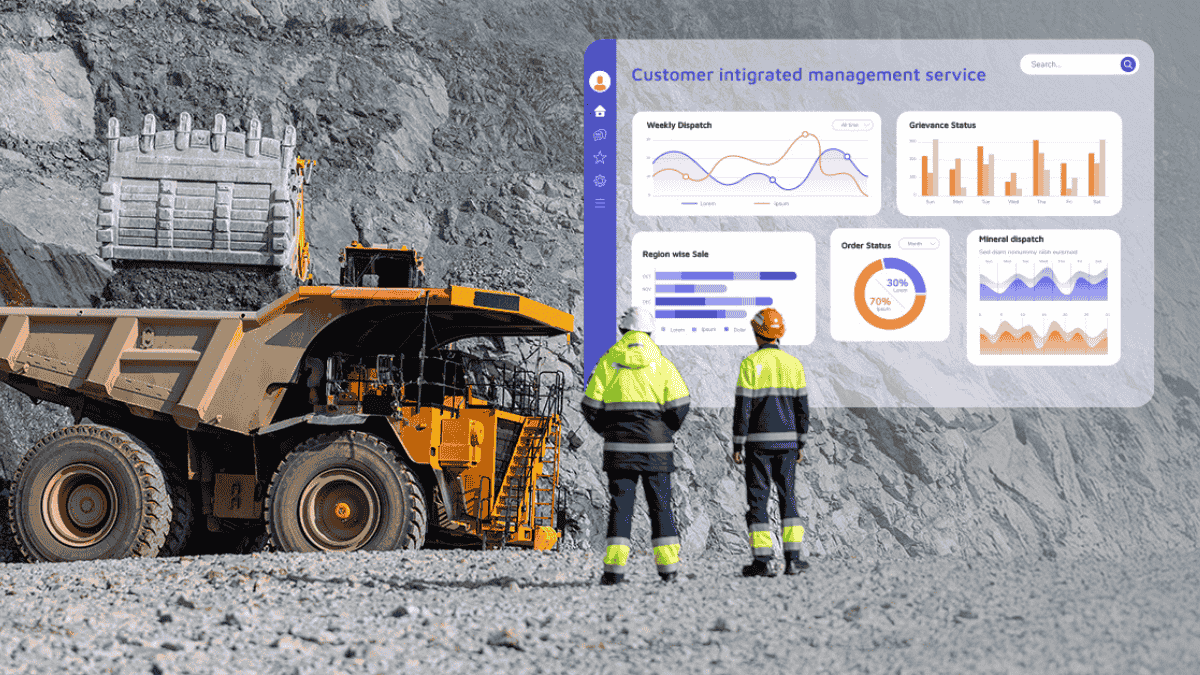
Consider mining revenue systems. On a whiteboard, the flow is straightforward: capture extraction -to- validate dispatch -to- compute royalty -to- flag anomaly.
But deployment rarely follows whiteboard logic. During monsoon season in one state-level rollout, weighbridge outages and rerouted transport created timing gaps the system interpreted as irregularities. Alerts increased. Officers faced pressure from both transporters and internal audit units. Temporary field adjustments, historically managed through documented discretion; were now flagged as deviations.
The platform’s logic was accurate. Its assumptions were incomplete. Revenue leakage did not return because analytics failed. It resurfaced because operational buffers, weather contingencies, and accountability structures were never formally modelled.
Similar patterns appear elsewhere:
- Hospital systems that technically streamline records but slow clinicians during shift transitions.
- Admissions platforms that assume centralized decision authority where committee negotiation is the real mechanism.
- Agricultural subsidy systems that ignore local verification dynamics and over-flag legitimate claims.
None of these breakdowns originate in model quality. They originate in misread environments.
Why Domain Expertise Is Now a Control Function
AI systems move closer to decision authority, with a result, the cost of contextual blind spots increases. Dashboards can be ignored. Automated enforcement recommendations cannot. Engineering teams implement what is specified. The specification itself becomes the risk surface. Experienced domain practitioners bring a different lens:
- Which delays are protective rather than inefficient
- Where discretion shields institutions from unintended liability
- Which legacy steps exist because of past failure, not bureaucracy
- How informal coordination actually sustains formal systems
These insights rarely appear in requirement documents. They are learned through exposure; audits survived, crises handled, policy shifts absorbed. This is exactly where The role of domain consultants becomes critical. Their operational experience, combined with growing demand for artificial intelligence consulting, helps organizations avoid designing technically correct systems that fail in real-world execution.
When that knowledge shapes system logic early, adoption patterns change. Not because users are persuaded. Because the platform reflects their operating reality.
The Structural Flaw in Many Transformation Programs
In many digital programs, domain engagement is front-loaded. Workshops are conducted. Requirements are documented. Reports are approved. Development proceeds. What often gets lost is judgment translation. The subtle understanding of when rules flex, when escalation protects, and when rigid enforcement creates secondary risk.
The highest-leverage interventions occur before workflows are frozen in architecture:
- Stress-testing exception paths against real incident scenarios
- Examining how accountability flows under audit pressure
- Identifying discretion points that must remain human
- Testing assumptions against peak-load or crisis conditions
These conversations are not lengthy. They are precise. And they prevent expensive behavioural drift later.
Implications for Experienced Professionals
For those who have worked inside regulated systems such as governance, healthcare, mining, agriculture, education etc., it’s been noticed AI has not reduced relevance. It has shifted where relevance applies. Operational experience now has disproportionate leverage at design stage.
In one pre-deployment review, a brief discussion around audit escalation pathways surfaced a structural flaw that would have forced manual overrides from day one. Correcting it required minor architectural adjustment early. Post-launch, it would have required institutional retraining and policy reinterpretation.
That difference is not technical sophistication. It is contextual fluency. This growing dependence on operational judgment further highlights the role of industry and domain consultants in ensuring digital systems align with institutional realities.
Expertise and Execution Must Converge
Sustainable AI deployment requires two equal capabilities, first “Engineering precision” and the other one is “Institutional memory”. When systems are built purely from policy diagrams and historical data, they tend to represent how processes are intended to function.
When domain experience is integrated, systems begin to reflect how decisions are actually made under pressure. The difference determines whether platforms become operating infrastructure or peripheral tools. AI accelerates system capability. It does not simplify institutional complexity. Ignoring that complexity is expensive.
Structured Domain Engagement
For decades, domain consulting has been central to how large public and regulated systems evolve. Long before AI accelerated digital transformation, institutional reforms depended on practitioners who understood not just policy, but execution.
We continue that tradition. We are strengthening our Industry Consultant empanelment for experienced practitioners who want their operational knowledge applied at defined inflection points in digital implementation.
We believe domain expertise is not advisory ornamentation. It is a structural input. Professionals who have worked inside complex operational environments and understand how decisions hold up under audit, political scrutiny, or field pressure, have a role to play beyond documentation.
We encourage experienced industry practitioners to contribute where their insight carries leverage not as peripheral reviewers, but as specialists shaping architecture at the right stage.
If you are interested in contributing to structured, high-impact engagements aligned with long-term public value, share your profile with us.


Recent Publications






- Agriculture and Allied Services
- AgriTech
- Application Development
- Artificial Intelligence
- Blockchain
- COVID-19
- CSM Editorial
- Data Analytics
- Digital service
- Digital Transformation
- Education
- EduTech
- Emerging Technologies
- Enterprise Resource Planning
- Food Security
- Golden Records
- GovTech Solution
- Green Jobs
- Healthcare
- HR Analytics
- Hybrid Work Culture
- Independence Thought
- Industry 4.0
- Innovation
- IT Consulting
- Land & Industry
- Life@CSM
- Memory Lane
- Mines & Minerals
- Mining Technology
- Opinion Piece
- Precision Agriculture
- Smart City
- Social Listening
- Social Media
- Social Registry
- Super Apps
- Tourism
- User Experience
- Web 3.0
- Work Culture



















We will verify and publish your comment soon.