







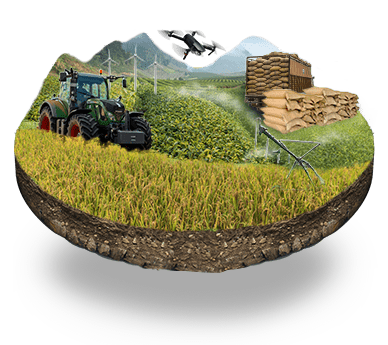











If Indian agriculture were a vast field, farm credit would be its irrigation canal. And today, that canal is unevenly dug. On one side stand large farmers with structured loans and institutional backing. On the other stand millions of smallholder farmers, cultivating less than two hectares, producing nearly half of India’s food, yet still negotiating credit with paperwork thicker than their crop yield.
.jpg)
The Structural Credit Gap in Indian Agriculture
India has nearly 146 million operational farm holdings, and 86% belong to small and marginal farmers. Yet formal agricultural lending has historically favoured scale over need. While total farm credit has surged past Rs 25 lakh crore in recent years, access remains uneven. Barely a third of farmers consistently access institutional loans. Many still rely on informal lenders charging steep interest rates that quietly erode profitability.
The issue is not liquidity in the banking system. It is structural friction. Smallholders often lack updated land titles, formal income records, or credit histories. Banks cite high servicing costs, perceived default risks, and policy uncertainties such as loan waivers. The result is a paradox: agriculture employs nearly half of India’s workforce, yet millions of those feeding the nation remain financially excluded.
Democratizing farm credit, therefore, is not a welfare intervention. It is an economic imperative.
From Collateral to Code: The Rise of Digital Financial Inclusion
Digital financial inclusion is fundamentally rewriting the grammar of agricultural lending. Instead of asking, “What asset can you pledge?”, lenders increasingly ask, “What does your data reveal?”
Alternative credit scoring models now analyse digital footprints such as mobile usage patterns, transaction histories, cooperative memberships, and input purchases to assess repayment capacity. A dairy farmer regularly receiving payments through a cooperative or a vegetable grower transacting through UPI becomes visible to the financial system in ways previously unimaginable.
India’s digital backbone has accelerated this shift. The JAM trinity of Jan Dhan accounts, Aadhaar identification and mobile connectivity has brought over 500 million citizens into the banking ecosystem. UPI transactions have grown exponentially, with rural adoption steadily increasing. The Kisan Credit Card scheme is progressively digitised through e-KYC, reducing onboarding time. PM-KISAN transfers have normalized direct digital payments for over 11 crore farmers, reinforcing familiarity with formal banking.
Emerging initiatives like AgriStack aim to create unified farmer databases linking digitised land records and scheme entitlements. The Data Empowerment and Protection Architecture strengthens consent-based data sharing, enabling farmers to control their financial information. Together, these frameworks shift power from collateral to credibility, from paperwork to data intelligence.
Satellite imagery, AI-based crop monitoring and weather-indexed insurance further enhance risk assessment. Lenders can estimate yield potential and climate exposure more accurately, reducing uncertainty and making farm loans more affordable.
.jpg)
Digitizing Trust: How CSM Is Enabling Data-Driven Credit for Smallholder Farmers
At CSM Technologies, we see farm credit not merely as a financial product, but as an enabler of dignity, productivity and rural prosperity. Our mission in democratising farm credit is rooted in building digital, unified and AI-driven ecosystems that place smallholder farmers at the centre of the lending value chain.
With SAFAL, Simplified Application for Agricultural Loans, developed in partnership with the Government of Odisha, we launched India’s first end-to-end digital agricultural credit facilitation portal. SAFAL connects farmers to over 500 loan products from more than 40 public, private and cooperative banks through a single, transparent interface. By integrating with the Krushak Odisha database of 6.6 million authenticated farmers, the platform enables instant Aadhaar-seeded verification, real-time application tracking and structured DPR templates, eliminating paperwork, middlemen and uncertainty.
Our Digital Warehouse Receipt System further transforms harvested produce into verified digital collateral, empowering farmers to access fair credit and avoid distress sales. Complemented by AI-powered crop analytics and blockchain-enabled procurement systems, CSM delivers data-driven lending intelligence that reduces risk for banks while accelerating disbursal for farmers.
The result is measurable impact: faster credit access, improved transparency, reduced transaction costs and enhanced financial credibility for smallholders. At CSM, we are not just digitising farm loans. We are architecting an inclusive agri-finance ecosystem that strengthens productivity, resilience and rural economic growth in India and beyond.
.jpg)
Building an Inclusive Agri-Finance Ecosystem
Yet technology alone does not guarantee inclusion. Digital democratisation faces persistent barriers.
Only a fraction of villages have full-fledged bank branches. Internet connectivity and electricity reliability vary. Digital literacy gaps remain significant, especially among elderly farmers and women. Trust deficits endure in communities accustomed to cash-based systems. An app in English with complex navigation is not empowerment; it is exclusion disguised as innovation.
To make digital farm credit truly inclusive, infrastructure expansion must be paired with human capacity-building. Multilingual interfaces, voice-enabled platforms, assisted banking through Business Correspondents, and training via Krishi Vigyan Kendras and Farmer Producer Organisations are critical. Financial literacy must become as fundamental as seed distribution.
Policy coherence is equally essential. Regulatory incentives for alternative credit scoring, stronger credit guarantees for smallholder loans, and seamless integration of agricultural databases can create a robust ecosystem. Agricultural lending should not be treated merely as a priority-sector obligation but as a strategic national investment in productivity and food security.
Imagine a marginal farmer in a remote village checking soil moisture data on her phone, applying for a crop loan through biometric authentication, receiving approval within hours, purchasing inputs digitally, and selling produce directly to buyers, all without travelling to a distant bank branch. This is not speculative fiction. The technological building blocks already exist.
What remains is alignment.
Democratizing farm credit through digital financial inclusion is about restoring agency to smallholder farmers. It is about ensuring that the hands that feed the nation are not financially invisible. When affordable, data-driven farm loans reach every marginal farmer, productivity rises, rural incomes stabilise, and economic resilience strengthens.
.jpg)
Coding the Future of Indian Agriculture
The future of Indian agriculture will not be written only in soil and monsoon cycles. It will be coded in data, secured through trust, and powered by inclusive financial architecture.
The call to action is clear. Policymakers must accelerate digital infrastructure and data interoperability. Banks must embrace alternative credit frameworks. Fintech innovators must design for vernacular realities. And collectively, we must recognise that financial inclusion in agriculture is not charity. It is strategy.
If we get this right, democratizing farm credit will not just transform lending. It will transform rural India itself.


Recent Publications




- Agriculture and Allied Services
- AgriTech
- Application Development
- Artificial Intelligence
- Blockchain
- COVID-19
- CSM Editorial
- Data Analytics
- Digital service
- Digital Transformation
- Education
- EduTech
- Emerging Technologies
- Enterprise Resource Planning
- Food Security
- Golden Records
- GovTech Solution
- Green Jobs
- Healthcare
- HR Analytics
- Hybrid Work Culture
- Independence Thought
- Industry 4.0
- Innovation
- IT Consulting
- Land & Industry
- Life@CSM
- Memory Lane
- Mines & Minerals
- Mining Technology
- Opinion Piece
- Precision Agriculture
- Smart City
- Social Listening
- Social Media
- Social Registry
- Super Apps
- Tourism
- User Experience
- Web 3.0
- Work Culture



















We will verify and publish your comment soon.