


















Administrative systems were never designed to feel human. Engineered for compliance, structure, and control, they have long spoken the dialect of documentation rather than empathy. For long, governance has meant red tape, dense legal jargon, and detached bureaucratic processes- a system built for the state, rarely for the citizen. Yet today, at the intersection of Artificial Intelligence (AI) and public service delivery, a quiet revolution is reshaping governance from the ground up. Policy is stopping being paperwork and starting to become a lived, accessible experience.
This is AI at the last mile- not as a concept, but as a breathing reality unfolding in India's smallest villages, dusty block offices, and tribal hamlets.
When Language Is No Longer a Wall
India is not one country- it is a mosaic of over 19,500 dialects (Linguistic Survey of India) and profound socio-economic complexity. For a citizen in rural Odisha or a tribal community in Jharkhand, a welfare notification in bureaucratic English or Hindi might as well be a foreign document.
Large Language Models (LLMs) are dissolving this barrier. According to the Ministry of Electronics and Information Technology (MeitY), AI-driven vernacular translation is now actively converting legal judgments, administrative directives, and public entitlements into regional languages - not word-for-word, but contextually intelligent, culturally resonant communications. Policies once locked behind legal jargon are now accessible in local dialects, making governance inclusive by design.
The result: citizens no longer "apply" blindly - they engage knowingly.
Multimodal AI assistants, accessible via smartphones — India crossed 800 million internet users in 2024, per TRAI - are turning complex policy documents into simple, spoken conversations. Grassroots NGOs in Bengaluru are deploying AI to handle routine civic guidance at scale, freeing human mentors for high-stakes conversations that no algorithm should own.
This is not mere digitization. This is democratization.
 (1).jpg)
The Human-in-the-Loop Imperative
Can an algorithm feel the weight of a widow's pension application? Can a machine understand the shame embedded in asking for food assistance? The answer, mercifully, is no and that is precisely the point.
The most effective model for AI governance today is not replacement but augmentation. The "Human-in-the-Loop" (HITL) philosophy, documented in frameworks assessed by MIT Sloan Management Review, argues that AI should absorb repetitive administrative burdens — form processing, eligibility checks, document verification — so the public servant becomes a strategic empathy layer. A frontline worker freed from paperwork becomes a guide, an advocate, a problem-solver.
This shift from rule-bound, design-time governance to adaptive, decision-time governance demands transparent, accountable systems. According to a 2024 KPMG India report on AI in the public sector, citizens adopt AI-driven services when they can see evidence of effectiveness not just in dashboards, but in their daily lives. Trust is not a feature; it is the foundation.

Inclusion Is Not Optional
Perhaps the most quietly radical development in India's AI governance journey is the Ministry of Tribal Affairs embedding AI into tribal development programs. In a country where inclusion has often been rhetorical, this signals something structurally different: technology designed to strengthen delivery while preserving cultural identity.
This distinction between AI as a tool of standardization and AI as a tool of equity is the defining question of our era. When a tribal student accesses a scholarship portal in their native language, or a widow receives her pension without intermediaries, or a citizen resolves a grievance without navigating a bureaucratic maze - AI has done its job. The true measure of success is not workflows automated; it is human experiences transformed. The question shifts from "How efficient is the system?" to "How understood does the citizen feel?"
Humanizing Governance with AI: How CSM is Transforming Citizen Experiences at Scale
At CSM Technologies, we believe the true power of AI lies not in sophisticated algorithms alone, but in its ability to make governance more accessible, inclusive, and human-centric. Our AI-driven GovTech solutions are designed to bridge the last-mile gap between public institutions and citizens, ensuring that critical services reach every individual with speed, transparency, and empathy.
Through AI-powered citizen engagement platforms, multilingual chatbots, and intelligent grievance management systems, we enable governments to deliver seamless, real-time support across diverse communities. Solutions such as DocoVault ARPANA and our intelligent service delivery frameworks simplify identity verification, automate document processing, and accelerate welfare disbursement while maintaining the highest standards of security and trust.
Our proprietary AI engines also empower data-driven governance by leveraging predictive analytics, satellite intelligence, and automated decision-support systems to optimize resource allocation, agricultural interventions, and public service delivery. Equally important, CSM Technologies' Responsible AI approach embeds explainability, accountability, and compliance into every solution, ensuring that innovation never compromises citizen trust.
By transforming complex administrative processes into intuitive citizen experiences, CSM is helping governments move from reactive administration to proactive, personalized governance- where technology speaks the language of people and public services become truly accessible to all.
Frameworks That Hold It Together
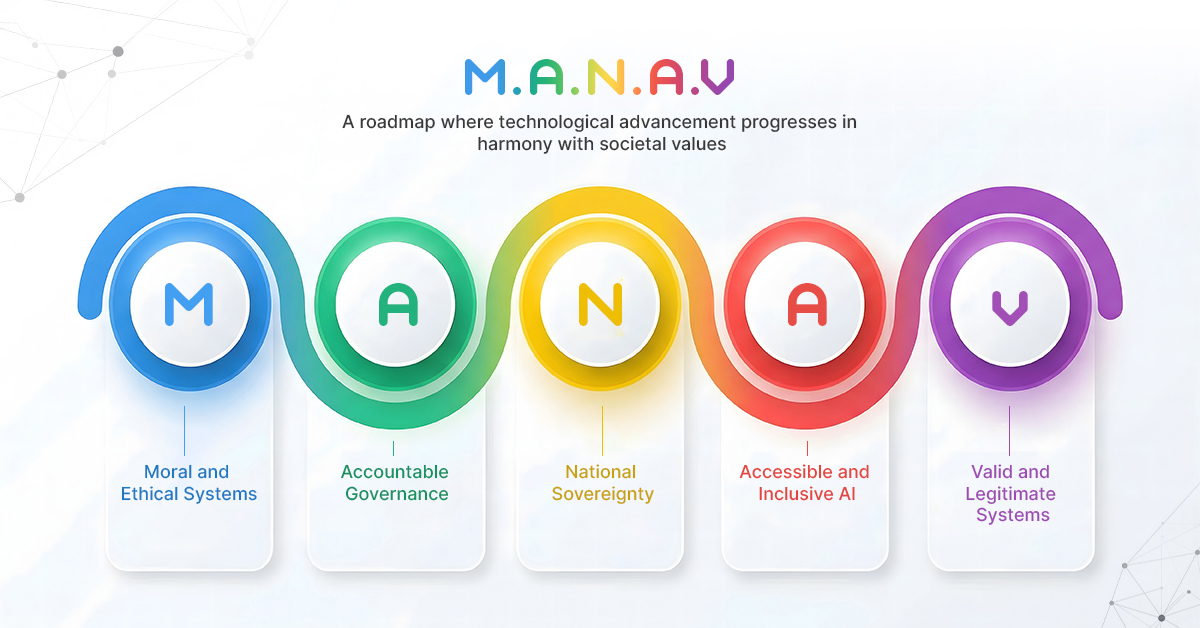
None of this scales without architecture. The Human-AI Governance (HAIG) trust-utility framework is among the most credible attempts to operationalize this balance — mapping precise boundaries between AI autonomy and human oversight, ensuring clear accountability for algorithmic suggestions alongside human regulators. The IndiaAI Mission complements this by building localized foundation models and sovereign computing infrastructure, recognizing that genuine AI equity cannot be outsourced to models trained on other nations' realities.
PM Modi's vision of India as a top-three global AI superpower by 2047, articulated at the Global AI Summit, is not merely geopolitical ambition. It is a design brief for governance: technology that reaches every citizen, in their language, through their device, on their terms.
The Last Mile Is Where History Is Made
As AI continues to evolve, the ultimate challenge is not technological - it is philosophical. Can machines help governance feel more human? At the last mile, the answer is already unfolding. AI is no longer simply processing policies; it is translating governance into dignity, access, and trust - one citizen at a time.
The grandest ambitions of AI will ultimately be judged not in research labs or unicorn valuations, but in the village where a farmer finally understands his entitlements, in the district office where a clerk has time to listen, and in the tribal school where a student accesses quality guidance for the very first time.


Recent Publications





- Agriculture and Allied Services
- AgriTech
- Application Development
- Artificial Intelligence
- Blockchain
- COVID-19
- CSM Editorial
- Data Analytics
- Digital service
- Digital Transformation
- Education
- EduTech
- Emerging Technologies
- Enterprise Resource Planning
- Food Security
- Golden Records
- GovTech Solution
- Green Jobs
- Healthcare
- HR Analytics
- Hybrid Work Culture
- Independence Thought
- Industry 4.0
- Innovation
- IT Consulting
- Land & Industry
- Life@CSM
- Memory Lane
- Mines & Minerals
- Mining Technology
- Opinion Piece
- Precision Agriculture
- Smart City
- Social Listening
- Social Media
- Social Registry
- Super Apps
- Tourism
- User Experience
- Web 3.0
- Work Culture


















We will verify and publish your comment soon.