





















Traditional APIs were written for humans who squint at documentation. AI agents don’t squint; they guess. Gartner predicts 33% of enterprise software will embed agentic AI by 2028, up from under 1% in 2024. If your APIs only speak to developers, your fastest-growing customers cannot hear you.
Traditional APIs were largely designed for software developers who could read documentation, interpret errors and intervene when something went wrong. AI agents need something different: interfaces they can understand, navigate and use safely with minimal human intervention.
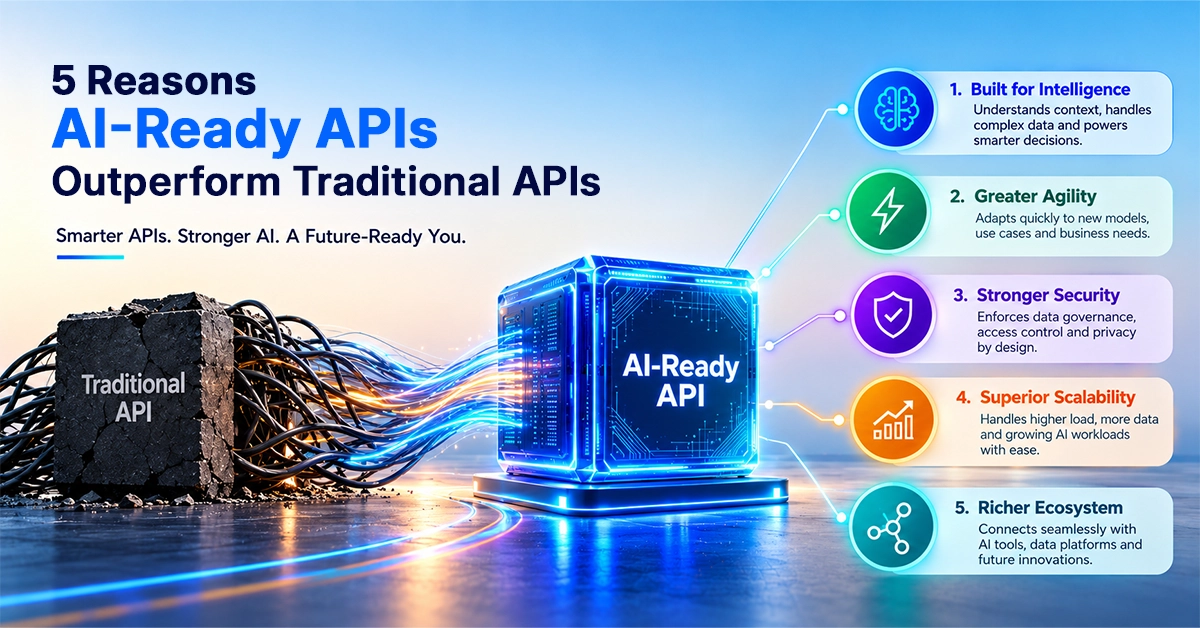
Here are five reasons why AI-ready APIs are becoming essential for enterprise AI adoption.
1. Dynamic Capability Discovery
Traditional APIs often depend on external documentation to explain endpoints, parameters and business logic. AI agents cannot reliably act on information they cannot access.
AI-ready APIs expose machine-readable descriptions, argument schemas and available tools through standards such as OpenAPI and the Model Context Protocol (MCP). This helps agents discover capabilities dynamically rather than guessing endpoint names.
For example, an AI assistant can identify the appropriate customer-information tool without relying entirely on a developer to explain the integration.
2. Structured and Predictable Error Handling
An ambiguous error can confuse an AI agent, triggering unnecessary retries or incorrect decisions.
AI-ready APIs return consistent, machine-readable errors that distinguish rate limits, invalid parameters and temporary network failures. This allows agents to determine whether to retry, wait or choose another approach.
The advantage is not merely better debugging. It is greater reliability across autonomous workflows.
3. Idempotency and Cost-Aware Execution
Idempotency means doing the same action multiple times but getting the same result as doing it once. When an API request fails midway, blindly repeating it can create duplicate payments, notifications or business transactions.
AI-ready APIs use idempotency keys, explicit side-effect declarations and controlled retry mechanisms to prevent unintended repetition. Cost-aware controls also help reduce wasted model calls and unnecessary processing.
For financial services, e-commerce and public-sector platforms, this distinction can protect both operational efficiency and user trust.
4. Leaner Payloads and Faster Performance
AI agents often process multiple API responses within limited context windows. Oversized JSON (JavaScript Object Notation) payloads consume tokens, increase processing overhead and obscure relevant information.
AI-ready APIs support filtering, pagination and progressive disclosure, delivering only the data required for a task. Semantic caching can further reduce redundant processing where appropriate.
The result is a leaner foundation for responsive, scalable AI applications.
5. Security Built for Autonomous Agents
Traditional API security must evolve when software can independently chain actions and execute multi-step plans.
AI-ready architecture combines granular authorization, rate limits, sandbox testing, monitoring and explicit execution boundaries. These controls help mitigate prompt-injection risks, unauthorized actions and runaway costs.
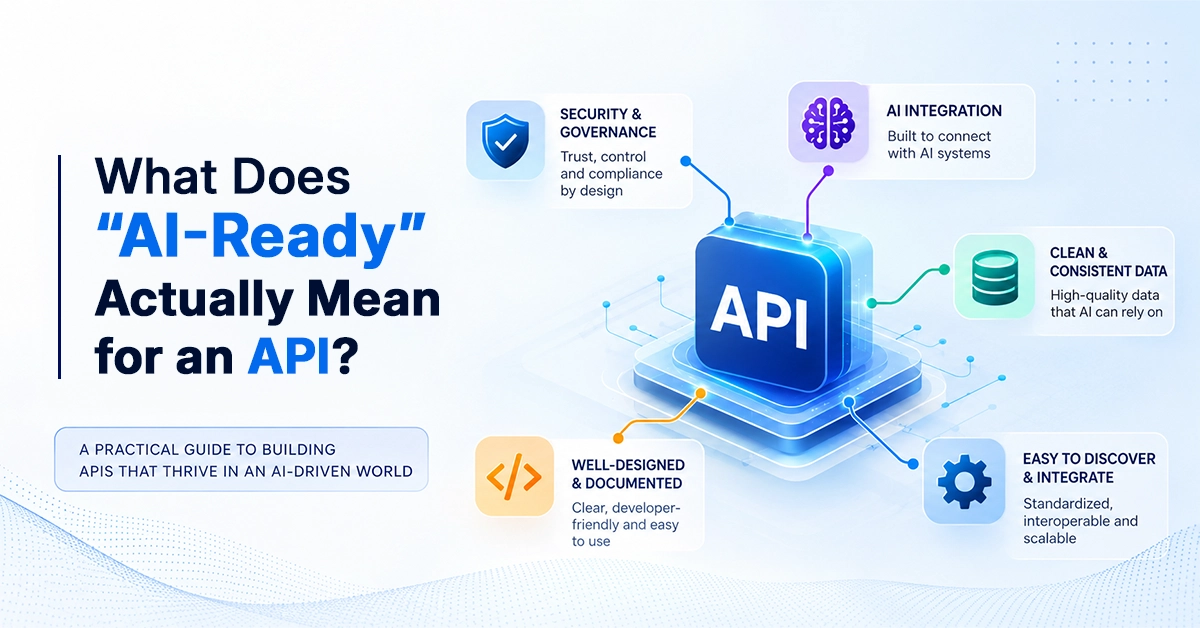
How CSM Technologies is Making Enterprise APIs AI-Ready
Traditional APIs connect systems; CSM Technologies is taking integration a step further by making enterprise capabilities accessible to AI assistants through MCP and MuleSoft Our approach transforms existing APIs into intelligent, conversational tools without redesigning the underlying integration architecture.
AI assistants can automatically discover relevant APIs, securely execute business operations, retrieve real-time information and deliver contextual responses in natural language. This addresses five critical enterprise needs: dynamic capability discovery, predictable error handling, safer execution, efficient data retrieval and governed AI access.
The result is faster development, improved API reuse, reduced onboarding effort and greater value from existing technology investments. For sectors such as governance, mining, healthcare, education and logistics, this creates opportunities to simplify complex workflows and accelerate informed decisions.
CSM’s vision is clear: build a future where AI becomes a secure, intelligent interface to enterprise systems, connecting human intent with trusted digital action.
Let’s Know the Uncomfortable Truth
Readiness is rarer than rhetoric. Only 24.3% of developers design APIs with agents in mind, and fewer than 40% of organizations enforce centralized governance, according to Postman. Gartner also expects over 40% of agentic AI projects to be cancelled by the end of 2027 over cost, unclear value and weak risk controls. Slapping an “AI-ready” label on a legacy API is not readiness; it is camouflage.
The Road Ahead
Tomorrow’s customers will be agents negotiating at machine speed. They will reward the businesses whose APIs speak clearly and punish those that mumble. Build for them, and you build for the next decade of the market.


Recent Publications





- Agriculture and Allied Services
- AgriTech
- Application Development
- Artificial Intelligence
- Blockchain
- COVID-19
- CSM Editorial
- Data Analytics
- Digital service
- Digital Transformation
- Education
- EduTech
- Emerging Technologies
- Enterprise Resource Planning
- Food Security
- Golden Records
- GovTech Solution
- Green Jobs
- Healthcare
- HR Analytics
- Hybrid Work Culture
- Independence Thought
- Industry 4.0
- Innovation
- IT Consulting
- Land & Industry
- Life@CSM
- Memory Lane
- Mines & Minerals
- Mining Technology
- Opinion Piece
- Precision Agriculture
- Smart City
- Social Listening
- Social Media
- Social Registry
- Super Apps
- Tourism
- User Experience
- Web 3.0
- Work Culture



















We will verify and publish your comment soon.