





















A farmer in Kenya receives a fertilizer subsidy directly to her phone within minutes of approval. A small merchant in Odisha accepts a payment from a stranger tourist from Bengaluru without setting up a card terminal. An Estonian citizen files her taxes in under three minutes, signs the return digitally, and sees exactly which government official accessed her record. A young entrepreneur in Manila opens a bank account using only a national ID issued through an open-source platform built in Bangalore.
These are four different countries, four different services, and four different decades of digital development. But they all run on the same underlying idea: a shared, interoperable, citizen-facing technology layer that anyone, public or private, can build on. That layer has a name now, and over the past three years it has moved from policy jargon into mainstream global vocabulary. It is called Digital Public Infrastructure, or DPI.
If GovTech is the broad practice of using technology to transform how governments serve citizens, DPI is the foundation that practice stands on.
.jpg)
What Exactly Is Digital Public Infrastructure?
The clearest definition came in September 2023, when leaders of the G20 nations gathered in New Delhi and, for the first time, formally adopted a shared description of DPI in their final declaration:
"Digital public infrastructure, as an evolving concept and as a set of shared digital systems, built and leveraged by both the public and private sectors, based on secure and resilient infrastructure, and can be built on open standards and specifications, as well as open-source software, can enable delivery of services at societal-scale." - G20 New Delhi Leaders' Declaration, September 2023
That paragraph took months of negotiation across twenty jurisdictions to finalize, and the language matters. DPI is not the name of a single technology. It is a category that describes shared, reusable digital systems, designed as building blocks rather than monolithic platforms, governed for public benefit, and capable of supporting service delivery at the scale of an entire population.
The simplest way to understand the relationship between the terms is hierarchical. GovTech is the practice. DPI is the foundation that practice rests on. Individual systems, a digital identity platform, a real-time payment rail, a land registry, are the actual building blocks. When governments invest in DPI, they are investing in the rails on which thousands of present and future services will run, the way roads and electricity grids became the rails of the industrial economy a century ago.
Why DPI Has Become a Global Priority
DPI moved from technical literature into top-table policy conversations remarkably quickly. India placed it at the centre of its G20 presidency in 2023, secured the first multilateral consensus on its definition, and followed up by launching the Global Digital Public Infrastructure Repository (GDPIR) in November 2023 to share country implementations openly. Brazil and South Africa continued the agenda in their subsequent G20 presidencies. The United Nations Development Programme and the World Bank now run dedicated DPI programmes.
.jpg)
The reason for the urgency is economic as much as ethical. The World Economic Forum estimates the broader GovTech market at approximately $606 billion in 2024, projected to reach $1.42 trillion by 2034. DPI is the share of that market with the deepest leverage, the one that unlocks every other public-sector digital service.
But the deeper reason DPI matters is structural. A country that builds a strong DPI layer once does not have to build identity, payments, or data-exchange logic again every time it launches a new public service. A welfare programme, a vaccination drive, a farmer subsidy, a tax credit, a student scholarship; all of them ride on the same rails. That is why DPI investment compounds, and why governments that get it right pull rapidly ahead of those that do not.
The Five Pillars of Digital Public Infrastructure
Every functioning DPI stack, whether in Tallinn, Singapore, New Delhi, or Kigali, rests on the same five foundational pillars. The names vary. The substance does not.
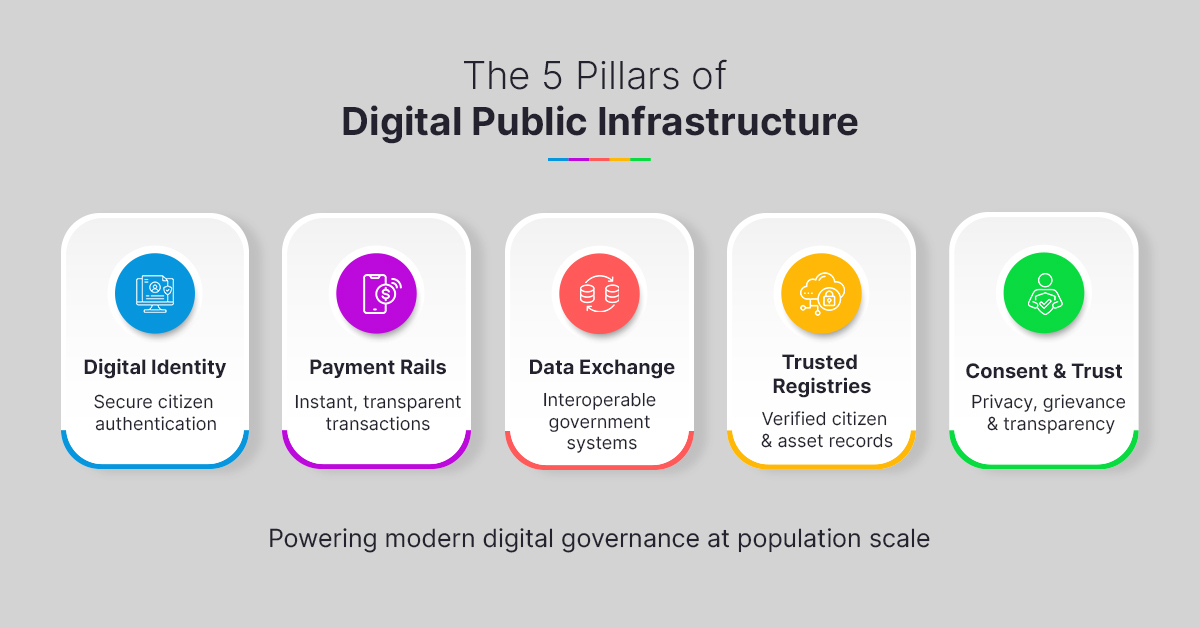
Pillar 1 - Digital Identity: The Gateway to Every Service
A digital identity system gives every citizen a unique, verifiable, privacy-preserving way of proving who they are online. Without it, nothing else in the DPI stack works. A welfare payment cannot reach the right person. A land record cannot be assigned to the right owner. A health record cannot be retrieved at the right hospital.
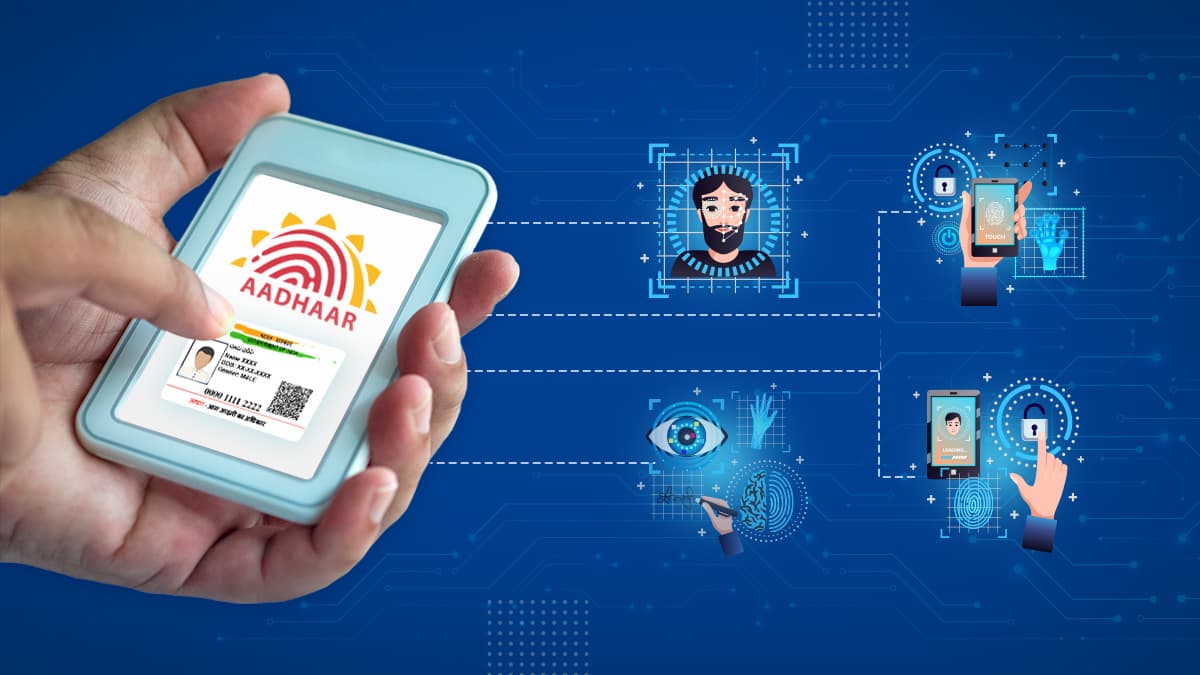
India's Aadhaar, with over 142 crore identities issued, is the largest digital identity programme in the world. Estonia's eID, Singapore's Singpass, and the European Union's eIDAS framework demonstrate parallel models in mature economies. But the most consequential global development is MOSIP, the Modular Open Source Identity Platform incubated at IIIT Bangalore in 2018. As of early 2025, MOSIP has engaged with 29 countries and is being deployed at national scale in eleven, including the Philippines (now at 94 million IDs issued and 170 million cumulative authentications), Morocco (25 million IDs, 80 million authentications), and Ethiopia (33 million IDs, 66 million cumulative authentications).
What makes a digital identity system genuinely DPI rather than merely a government IT product is its design. Open standards. Vendor neutrality. Privacy-preserving architecture. The ability to authenticate without revealing more data than the transaction requires. Built badly, digital identity becomes a surveillance tool. Built well, it becomes the most empowering single piece of public infrastructure a country can deploy.
CSM Technologies has worked extensively in this domain. In Africa, CSM has built digital identity management systems tailored to context-specific national ID programmes.
Pillar 2 - Real-Time Digital Payment Rails
If identity is the gateway, payment rails are the artery. A modern DPI stack includes an instant, low-cost, interoperable payment system that allows money to move between any two parties, any bank, any digital wallet, any time of day.
India's Unified Payments Interface (UPI) processed approximately 2,234 crore transactions worth Rs 28.81 lakh crore in April 2026 alone, and now accounts for an estimated 49 percent of all real-time payments in the world. Brazil's PIX, launched in November 2020, has matched that trajectory in record time: by September 2025 PIX had processed 196.2 billion cumulative transactions worth roughly $16 trillion, with over 175 million users, equivalent to 93 percent of Brazil's adult population.
Government-to-citizen money transfers, what India calls Direct Benefit Transfer, are the welfare application of the same rails. Between 2015 and 2023, India's DBT system disbursed over Rs 44 lakh crore directly to beneficiaries and saved an estimated Rs 3.48 lakh crore in leakage, while removing more than 5.87 crore ghost ration cards and 4.23 crore duplicate LPG connections from the rolls.
Pillar 3 - Data Exchange and Interoperability
A digital government that cannot share data internally is just paper bureaucracy with screens. The third pillar of DPI is the system that lets different government departments, and authorized private parties, exchange data securely, with consent, and without duplicating it into a central honeypot.
Estonia's X-Road, launched in 2001 and still the global gold standard, connects over 929 institutions and processes more than three billion data queries every year. Crucially, X-Road has no central database. Each institution holds its own data; X-Road simply enables them to query each other under tightly governed rules. Estonia estimates that the platform saved its citizens and government 2,589 working-years in a single calendar year. (Source: Future Shift Labs, X-Road Technology brief)
India's parallel innovation is the Account Aggregator framework, a consent-based data-sharing system that allows individuals to authorize the controlled transfer of their financial information between institutions for specific purposes and time windows. It is one of the first DPI components designed around the consent of the data subject rather than the convenience of the data holder.
CSM's contribution to this pillar includes CSM DocoVault, a secure document exchange and management system used across government agencies, and unified citizen portals that consolidate departmental services behind a single citizen-facing interface.
Pillar 4 - Trusted Registries
Identity tells the system who you are. Payments tell the system money has moved. Data exchange lets the system talk to itself. But none of it works without authoritative, current, trustworthy registries: of citizens, of farmers, of land parcels, of businesses, of beneficiaries, of vital events.
A registry is a deceptively simple thing, a database of who or what is real. But at population scale, with millions of additions and corrections each year, getting a registry right is one of the hardest engineering challenges in public technology. The payoff is enormous. Rwanda's land registry digitization, supported by the IremboGov platform, has reduced service times from five days to twenty-four hours and saved citizens over 120 million hours of travel and queuing collectively.
India's emerging Agri Stack and Farmer Registry, together with state-level land record digitization programmes, demonstrate the same logic in the agricultural and land domains. A verified farmer registry is the precondition for direct subsidy transfer, crop insurance, credit access, and procurement automation, none of which work reliably on top of incomplete or fraudulent records.
CSM’s registry portfolio is one of the deepest among GovTech firms. The Social Protection Delivery Platform (SPDP) enables governments to build a unified, interoperable system for beneficiary identification, scheme delivery, payments, grievance management, and social program monitoring at scale. The Unified Farmer Registry creates an authenticated single source of truth for agricultural beneficiaries. LANDMAS provides a unified, paperless system for industrial land allotment, plan approvals, and post-allotment management. CSM has also implemented large-scale social registries and beneficiary management platforms across Africa, where verified citizen and producer data forms the backbone of welfare delivery, agricultural governance, and evidence-based policymaking.
Pillar 5 - Consent, Trust, and Grievance Redressal
The final pillar is the one most often overlooked, and the most consequential when it fails. DPI moves citizens' data, payments, and identities at unprecedented speed. If citizens cannot see what is happening to their information, cannot revoke consent, cannot register a grievance and receive a response, the entire system loses legitimacy.
Estonia made this principle architectural. Every Estonian citizen can log in and see exactly which official, in which department, accessed her records and why, a transparency feature embedded in the platform's design rather than bolted on as a policy. India's Digital Personal Data Protection Act, passed in 2023 and operationalized progressively since, gives citizens statutory rights of access, correction, and consent withdrawal across DPI-enabled services. Brazil's LGPD and the EU's GDPR play similar roles in their jurisdictions.
The other half of this pillar is grievance redressal. A digital service that breaks silently is worse than a paper service that fails visibly. Modern GovTech systems integrate omnichannel grievance management, citizen feedback aggregation, and AI-assisted ticket triage as part of the core stack, not as an afterthought.
CSM's work in this pillar includes CSM CivicMeter, a citizen-engagement and feedback platform designed to integrate with existing government systems, and the Grievance and Feedback Management System. In East Africa, CSM has documented the transition to digital grievance handling in its review of citizen grievance management in Kenya.
.jpg)
The Global South Is Where DPI Innovation Is Happening Fastest
The conventional view of digital government places the leaders in Estonia, Singapore, and South Korea. That ranking is still broadly accurate at the level of maturity scores. But at the level of new DPI deployment, the centre of gravity has moved decisively to the Global South.
India is the most obvious case. India Stack, the collective name for Aadhaar, UPI, DigiLocker, the Account Aggregator framework, and related components, is now the most copied DPI blueprint in the world. MOSIP, the open-source descendant of the Aadhaar approach, is the foundation layer for national ID programmes in Ethiopia, Morocco, the Philippines, Sri Lanka, Togo, Uganda, Sierra Leone, Guinea, Burkina Faso, Madagascar, and Niger, with several more in active piloting.
Africa is moving fastest in operational terms. Rwanda's Cooperative Management Information System digitized the country's cooperative sector. Its integrated land management approach has become a reference case for the African Union's broader land governance agenda. Kenya, Ethiopia, the Gambia, and Malawi are deploying DPI components across social registries, beneficiary management, and warehouse receipt systems. The full breadth of this work is visible on CSM's Africa governance and public services portfolio.
Rwanda's IremboGov platform now delivers 247 government services from 38 institutions, with service delivery times reduced from 5 days to 24 hours and over 120 million citizen-hours saved. The Global South is not catching up on DPI. In many respects, it is setting the pace.
The reason for this acceleration is partly historical. Countries without entrenched legacy systems can leapfrog. Countries with younger demographics adopt new digital habits faster. And countries supported by open-source DPI components, MOSIP, X-Road derivatives, and others, do not have to pay the costs of building from scratch.
What Comes Next: The AI Layer on Top of DPI
DPI gave governments digital plumbing. The next layer being built on top of it is intelligence. Across the same five pillars, governments are now experimenting with AI applications that ride on the rails DPI has put in place.
Conversational AI assistants are appearing inside citizen portals, allowing citizens to navigate complex schemes by chatting in their own language. Computer vision systems are validating identity documents and detecting fraud in welfare claims. Predictive analytics are flagging the risk of school dropout, crop failure, or epidemic outbreak in time for intervention. Agentic AI systems are beginning to triage grievances, route them to the right department, and follow up on resolution.
The crucial point is that none of this AI works without a strong DPI foundation underneath. An AI grievance triage system is only as good as the citizen identity, registry, and grievance database it draws from. A predictive welfare model is only as good as the beneficiary data on which it is trained. AI is the intelligence layer. DPI is the substrate that makes it possible.
DPI gave governments their digital plumbing. AI is the intelligence flowing through it. The countries that build both layers well will define the next decade of public service delivery.
This is the territory CSM's AI and Allied Services practice is increasingly active in, applying agentic chatbots, document validation, video analytics, and grievance intelligence to government platforms across India and Africa.
Building DPI in Practice
Defining DPI is easy. Endorsing it in a G20 declaration is also relatively easy. Building it well, at population scale, under fiscal constraints and political pressure, is the actual challenge. That work is done by specialized firms with deep public-sector experience, working as long-term partners to governments and ministries.
CSM Technologies has been building components of what is now called Digital Public Infrastructure for 28 years, since well before the term existed. In India, that work includes Aadhaar-compliant data vaults, farmer registries used in central and state schemes, scheme monitoring platforms aggregating welfare data across departments, and grievance redressal systems serving citizens at scale. In Africa, CSM has implemented social registries, digital warehouse receipt systems, cooperative management systems, and land management platforms across Ethiopia, Kenya, Rwanda, Malawi, and The Gambia. Across all of this, the operating philosophy has been consistent: build for the citizen, build for interoperability, build for the next decade rather than the next quarter.
The five pillars are not theoretical. They describe the categories of work that go into every serious GovTech engagement. The countries that get the foundations right are the ones whose citizens will, increasingly, never have to think about government as a separate thing they queue for. To explore how this is applied across sectors, visit CSM's Governance and Public Services portfolio.


Recent Publications





- Agriculture and Allied Services
- AgriTech
- Application Development
- Artificial Intelligence
- Blockchain
- COVID-19
- CSM Editorial
- Data Analytics
- Digital service
- Digital Transformation
- Education
- EduTech
- Emerging Technologies
- Enterprise Resource Planning
- Food Security
- Golden Records
- GovTech Solution
- Green Jobs
- Healthcare
- HR Analytics
- Hybrid Work Culture
- Independence Thought
- Industry 4.0
- Innovation
- IT Consulting
- Land & Industry
- Life@CSM
- Memory Lane
- Mines & Minerals
- Mining Technology
- Opinion Piece
- Precision Agriculture
- Smart City
- Social Listening
- Social Media
- Social Registry
- Super Apps
- Tourism
- User Experience
- Web 3.0
- Work Culture

















We will verify and publish your comment soon.